Big Words start conversations and open doors to new places.
Author: anwaryusef
Anwar Y. Dunbar is a Regulatory Scientist. Being a naturally curious person, he is also a student of all things. He earned his Ph.D. in Pharmacology from the University of Michigan and his Bachelor’s Degree in General Biology from Johnson C. Smith University (JCSU). Prior to starting the Big Words Blog Site, Anwar published and contributed to numerous research articles in competitive scientific journals reporting on his research from graduate school and postdoctoral years. After falling in love with writing, he contributed to the now defunct Examiner.com, and the Edvocate where he regularly wrote about: Education-related stories/topics, Science, Technology, Engineering and Mathematics (STEM), Financial Literacy; as well as conducted interviews with notable individuals such as actor and author Hill Harper. Having many influences, one of his most notable heroes is author, intellectual and speaker, Malcolm Gladwell, author of books including Outliers and David and Goliath.
Anwar has his hands in many, many activities. In addition to writing, Anwar actively mentors youth, works to spread awareness of STEM careers, serves on the Board of Directors of the Friends of the David M. Brown Arlington Planetarium, serves as Treasurer for the JCSU Washington, DC Alumni Chapter, and is active in the Dave Ramsey Financial Peace Ministry at the Alfred Street Baptist Church. He also tutors in the subjects of biology, chemistry and physics.
Along with his multi-talented older brother Amahl Dunbar (designer of the Big Words logos, inventor and a plethora of other things), Anwar is a “Fanboy” and really enjoys Science-Fiction and Superhero movies including but not restricted to Captain America Civil War, Batman vs. Superman: Dawn of Justice, and Prometheus. He is a proud native of Buffalo, NY.
Some of the key focuses of my blog are: Financial Literacy, Wealth Building, Business and Entrepreneurship. A key to effectively doing business in today’s world is the proper and most efficient use of Social Media. The following contributed post is thus entitled; Is Your Company Using Social Media Correctly?
* * *
There is no getting away from the fact that social media has revolutionized the way in which most companies operate these days. If you’re just starting out in the business world; you might struggle to work out how to use those platforms to your advantage. With that in mind, take a moment to read this post, and it should help to point you in the right direction.
Use social media for marketing
Sites like Facebook and Twitter are excellent tools for promoting your business and reaching lots of new customers. There are paid advertising tools on both of those platforms, and there is no minimum spend. So, you can mess around with the targeting options until you find something that works. You can then make a more substantial investment.
Use social media for customer service
Facebook is one of the easiest ways to keep in touch with people these days. So, maybe you should undertake customer service duties on that platform? The infographic below will let you know more about social media and customer service so make sure you check it out!
Use social media to keep up to date
As an industry leader; you need to keep abreast of the latest news. Social media platforms are often the best way to make sure you don’t miss anything, and you’ll usually find the news on those sites first.
Now you know how to use social media correctly; nothing should stand in the way of your success. Remember to take a look at the infographic below for extra tips and tricks.
Two of the focuses of my blog are Financial Literacy and Money. In some instances, it’s important to know when to take out a loan if there is a financial crisis and there are no other options left. The following contributed post is thus entitled, Know When To Call Upon The Power Of A Loan.
* * *
The rut of financial baggage is relentless and tiring. It happens to us all at least once through our lives, but because it can go on and on, we feel like it’s normal. Well, newsflash, it isn’t and no one should ever think that it is something we should be okay with either. Firstly you need to pinpoint the reasons as to why you are in this mess whereby you can’t seem to pay your bills on time, you’re cutting back on the things you need for your family such as groceries and clothes, and yet still here you are sat up late at night with a calculator in your hand. Life shouldn’t be a game of catch up but it ends up being that way when we are irresponsible with our finances, going in over our head and getting into debt. Slowly but surely, if you cannot seem to stop the ball of debt and financial burden from rolling, eventually it will roll over you. But when is it really the best timing to go for a loan to help alleviate the pressure?
Living lavishly
Human beings are just strange creatures at the end of the day, we mostly cause our own problems. It’s hard to admit but you need to seriously question if you’re living a life that you honestly should not be. Have you bought a car that looks and feels good to drive but the gas mileage is pathetic? Do you buy too many clothes just to look good at events that don’t really matter? Could you possibly be a little too passionate and keep buying tickets to your favorite sporting team’s matches? We need to stop living lavishly when we know we don’t have the money. Many people will try to make excuses such as needing to feel good about yourself when you’re sad and depressed, or trying to live a normal life for the family etc. well, tough luck, it’s time to seriously question whether you should be buying some things when you know you are in a pinch.
Do you have a plan
What if you had a bag full of money thrown at you, what would you do? Just for the sake of argument, it’s only enough to pay off your debts and start to control your finances. Do you know what you would do first? What bills, debts, credit cards and such would you pay off immediately? If you haven’t even thought about the long-term solution to your financial burdens, your short-term plans are almost nonsensical. Paying off this week’s debt is a single drop in the ocean, what about the tens of thousands of dollars you owe for your mortgage, car payments, phone contracts and more? Create a plan that deals with a point by point analysis of what is most important financially, and then come up with monetary rules for paying off those problems first and foremost.
Measure the deepness
Loans are a great financial tool to use when you need to just throw money at the problem to make it go away. They do provide you with a lot of power to end some financial crisis situations, that much cannot be denied. But, they come with their own set of rules as they are a solution but also a new addition to your financial responsibilities. Use this information that compares direct lenders only and see what kind of APR rate and interest is best suited to you. Some lenders charge high rates as they want to aggressively control how and when you start repaying them. Others are more open to allowing you to figure out what the best plan would be. You can get a small loan of around three to four figures or you can get into the five-figure sums if you need a large quantity of cash.
Take the hit
No one wants to dip into their savings account to get from under a financial jam, but you have to be willing to do so. If the worse comes to worse, then you need to set a limit on how much you will be eating into the money you have been saving all your life. Take the hit and stop yourself from going under. Filing for bankruptcy is going to be much worse than halving or completely devouring all your savings. As much as it hurts, set a plan in place for how much money you will take out of your savings account to help pay for your debts. Setting a threshold for how much money you have left in your main bank account is a common way of doing this.
Use debt as an investment
One of the best times to use a loan is when you’re investing in something that is going to potentially make you more money in the future. A mortgage can be seen as a form of investment because you’re paying off a property that will likely appreciate in value. A business loan is a form of investment because it enables you to start a profitable business which could make you a sizable income. A student loan is similarly a worth investment because it could allow you to access higher salary careers. Of course, you don’t always have to rely on a loan. For example, when funding college, it’s possible to use savings or look for scholarships as offered by American Water. However, loans tend to be the most accessible option.
Loans have the ability to put a large chunk of money right in your hand, in a very short amount of time. Therefore they have a lot of power to aid you in your financial troubles. However, know when you need to call upon a loan and devise structures so you make good use of the money.
Two of the focuses of my blog are Current Events and Social Discussions. We are currently living in unprecedented times, with new events unfolding every day within our country and around the world. The following contributed post is thus entitled, The Biggest Problems Still Facing The Country.
* * *
It has been an incredibly strange year. As we get deeper into the second of 2018, it’s important to peel our eyes away from the drama that continues to play on the TV (or on Twitter) and to gain a little perspective. Here, we’re going to look at some of the biggest problems still affecting the country and what everyday people like us can do about them.
Safety in our schools
At the time of writing, there have been 32 school shootings in the country this year. If that statistic doesn’t highlight that we still have a huge issue with safety in our schools, then nothing else will. A lot of the debate around the issue has revolved around gun control, with even the idea of arming teachers thrown into the mix. The idea of teachers with a gun or having the permit for concealed carry weapons can leave us a little on the concerned side. It is not an ideal situation but the fact that an individual can cite the case District of Columbia v. Heller 553 deciding that individuals can bear arms for self-defence reasons means that there has to be another approach. However, the mental health aspect of our school safety issue should not be overlooked. One of the solutions that we might be able to push more plausibly than the tricky issue of the 2nd Amendment is the support and call for more school counselling programs.
Hurricanes Maria and Irma
The scope and longevity of the destruction caused by last year’s fall hurricane season is regularly underestimated. Not only is there still widespread damage done to the communities hit, with final fatality tolls still up in the air, we don’t give all communities equal attention. The Virgin Islands suffered their costliest hurricanes. Businesses like Cane Bay Partners have set up initiatives to help with the efforts of long-term recovery, as well as supplying generators, clean drinking water, and even temporarily housing displaced residents. If you’re planning on offering donations or even volunteering, Puerto Rico isn’t the only victimized community you need to consider.
The border
It’s a politically touchy subject, and many might support the greater efforts to enforce immigration control. However, the implementation has undoubtedly been a disaster with children held in shelters that have been seen to provide sub-par care time and time again. There are a host of charities like RAICES, providing immigrant families and refugees with affordable legal advice, and Border Angels, who fund education programs and immigration services to those in need.
Health care
The problem of how we deal with those in need of treatment they can’t access pops up yet again. The two parties fight over health care time and time again. There’s a growing 71% of the population in favor of changes like Medicare for All. However, while the political ball might take a long time to shift, there’s a lot we can do individually. Volunteering opportunities from Public Health involve not only volunteering free care for health industry professionals but efforts at places like shelters and hospices where even those without training can lend aid to the hard-working staff.
Getting caught up in the political melee can all-too-easily make us forget the real issues still affecting the lives of our countrymen. By getting a little perspective, we can contribute our energies and perhaps even a little time or money to really improving lives.
“When you have so many great teams that have been there before you, you’re not competing against the best in Western New York, you’re competing against history. We didn’t care about beating St. Joe’s or Buffalo Traditional! Could we be better than the team we were on last year?”
The first principle of my blog is Creating Ecosystems of Success. A key aspect of creating them is hearing the stories and experiences of those who have made it to where we want to be. Like many kids, an early dream of mine was to play basketball. That dream didn’t reach fruition, but the lessons I learned playing in Section VI, the New York State Public High School Athletic Association’s western-most section, laid the groundwork for me to go on to further my education and start my science career.
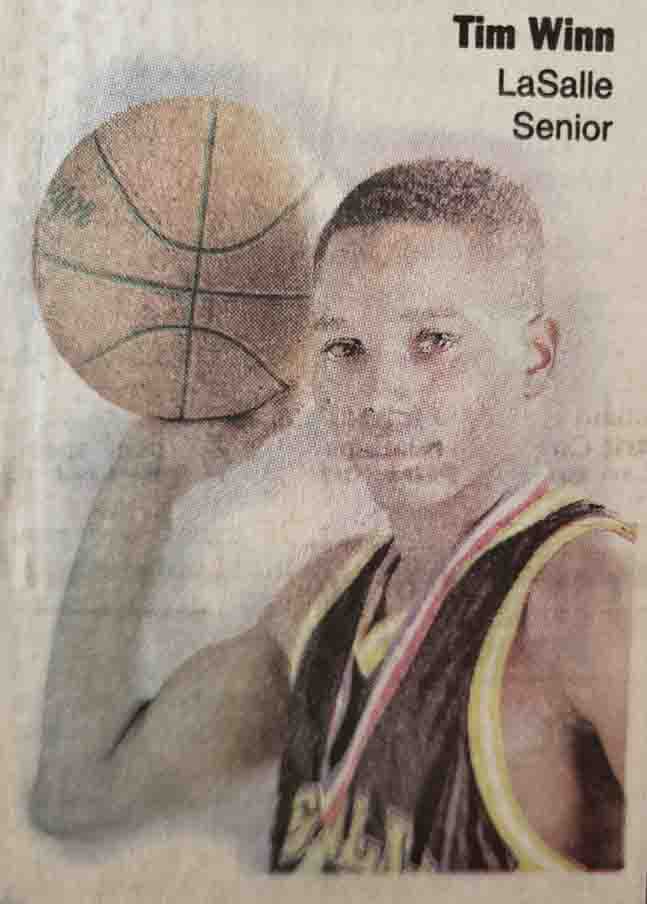
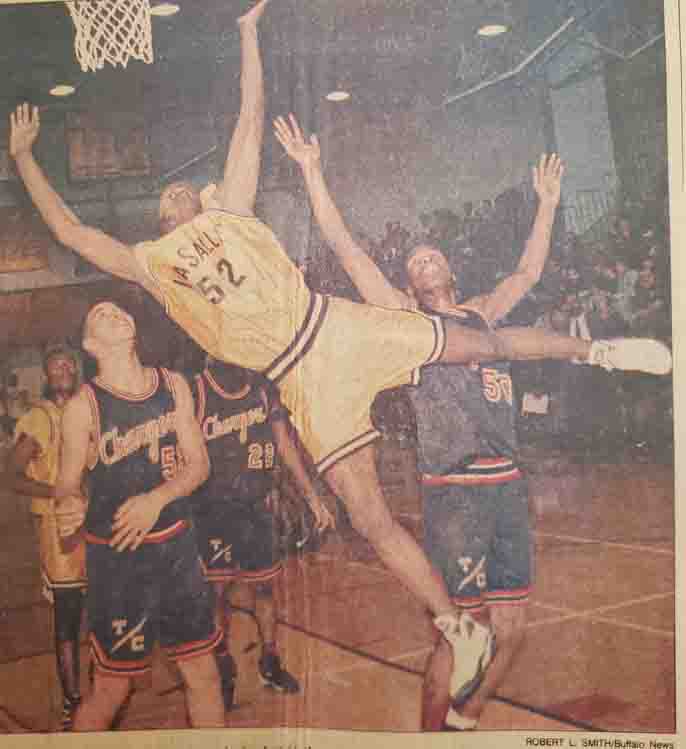
I’m working on a book project chronicling my early journey entitled, The Engineers: A Western New York Basketball Story. As a part of the research for that project, I’ve interviewed numerous Section VI basketball players and coaches from my era. On June 4, 2018, I had the honor of interviewing Tim Winn – a Western New York basketball legend and one of the last in a long line of great point guards in the LaSalle basketball dynasty – arguably the most dominant high school basketball program ever in Section VI and the Western New York region. In the early- mid-1990s, Tim Winn was Western New York’s other top point guard alongside Buffalo Traditional’s Jason Rowe, and has the distinction of making the State Tournament in Glens Falls each of his four years in high school.
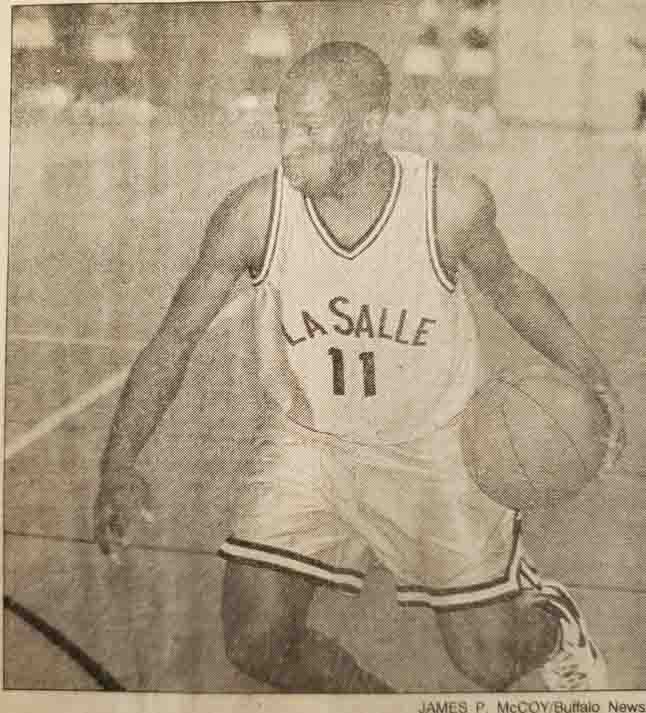
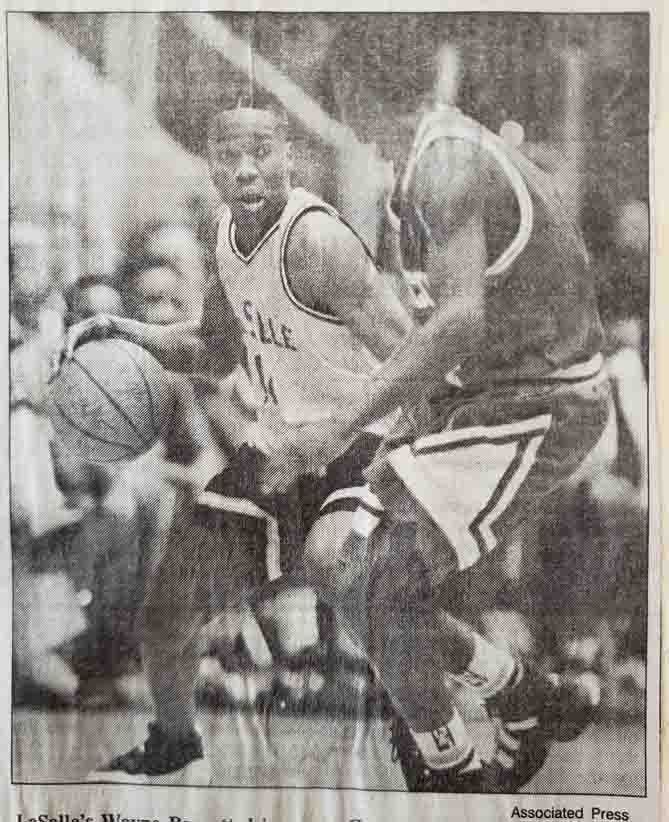
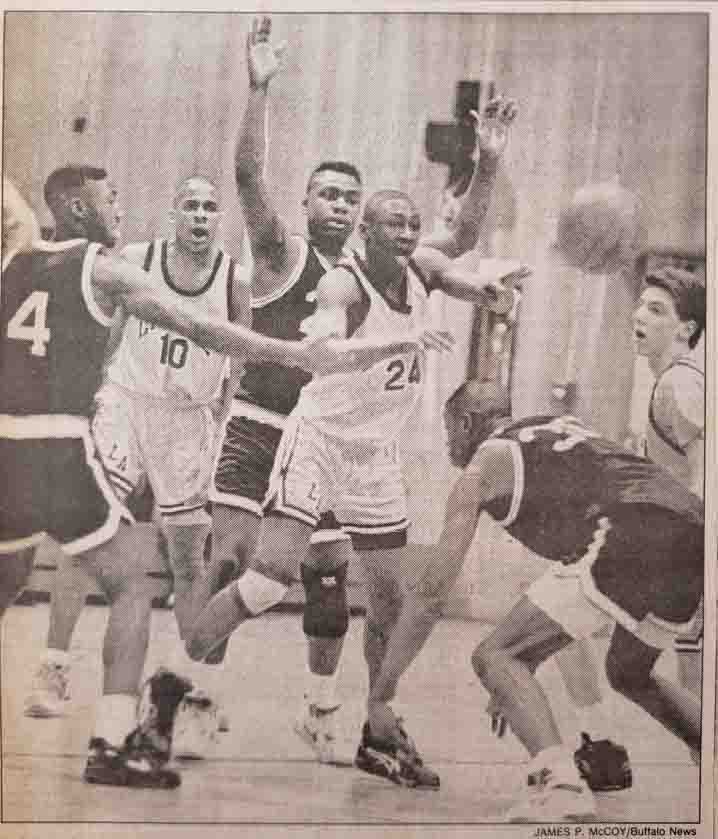
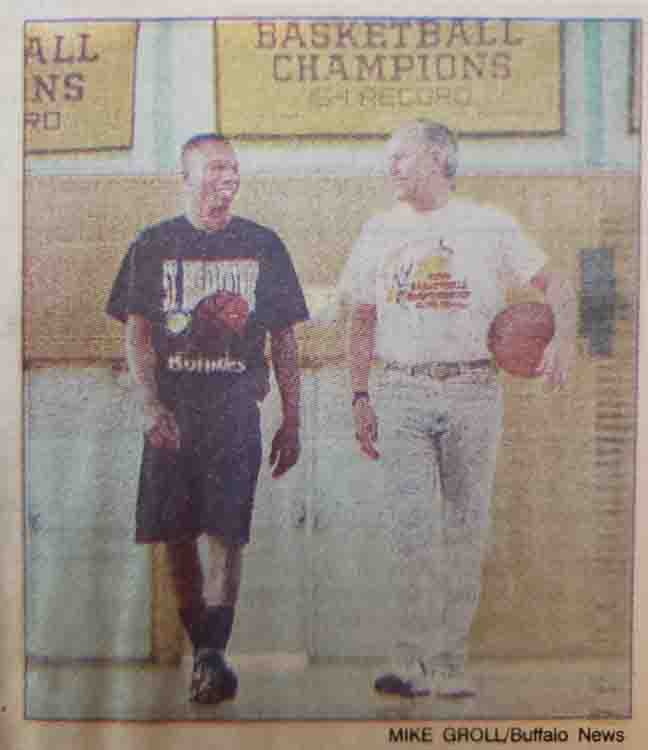
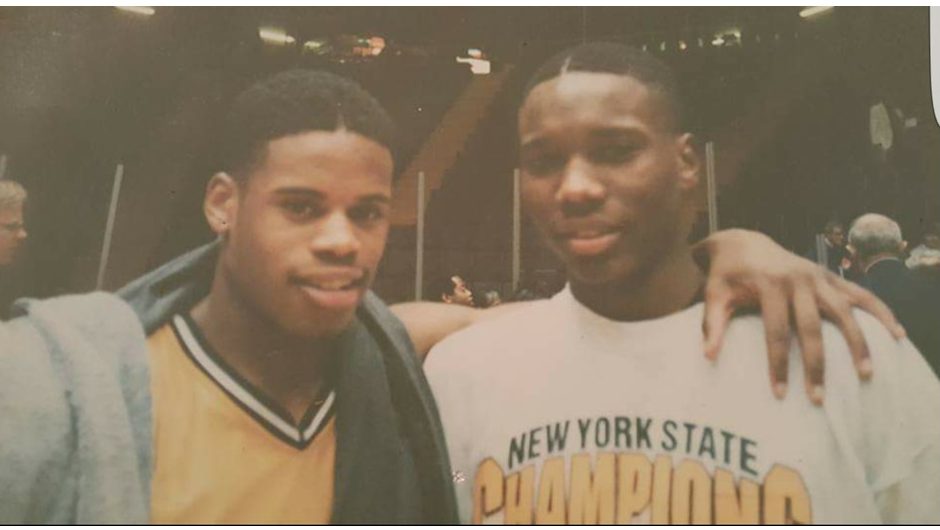
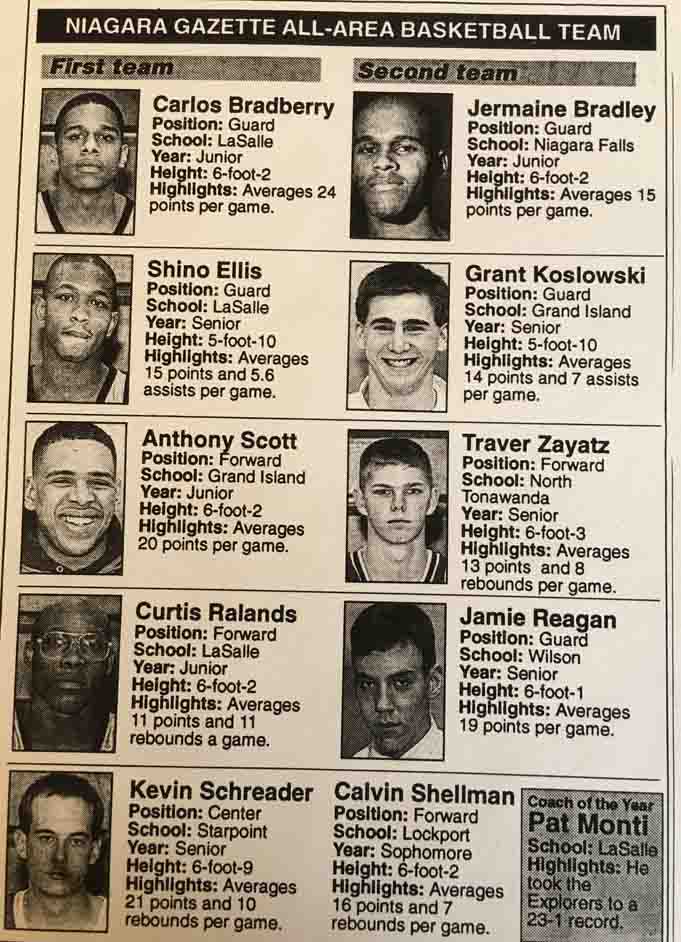
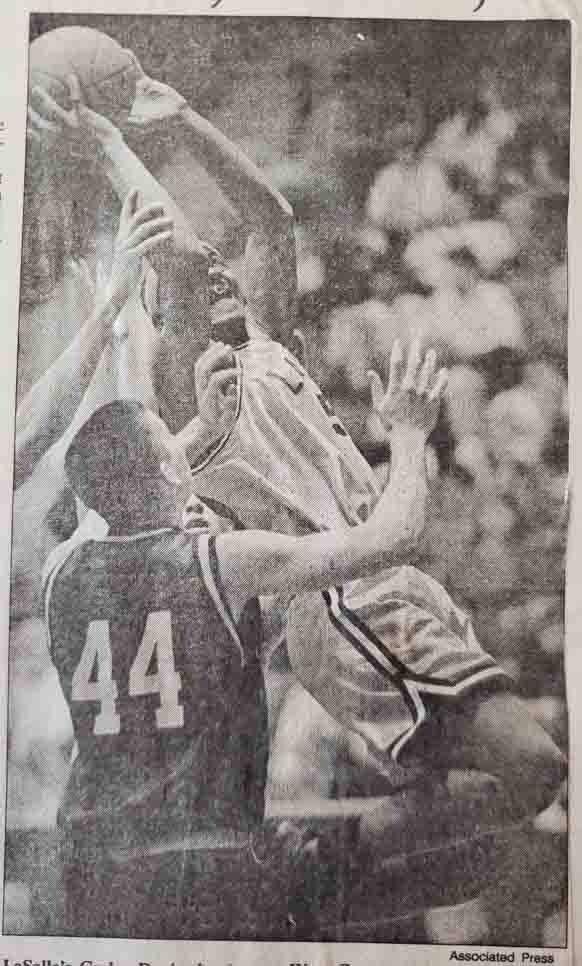
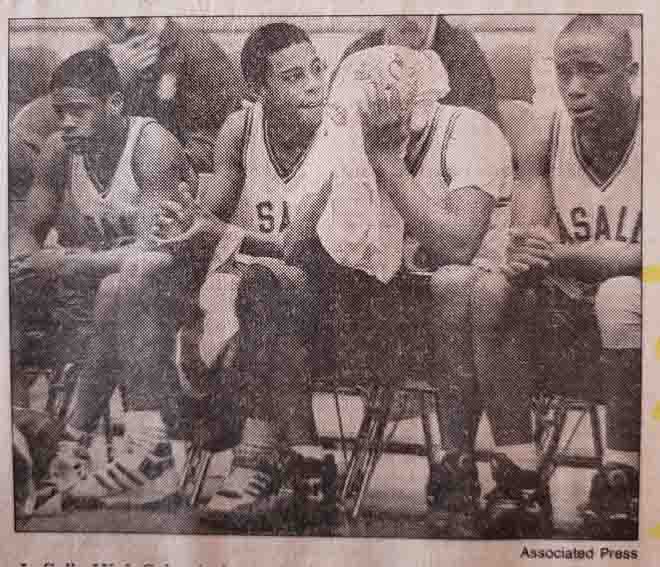
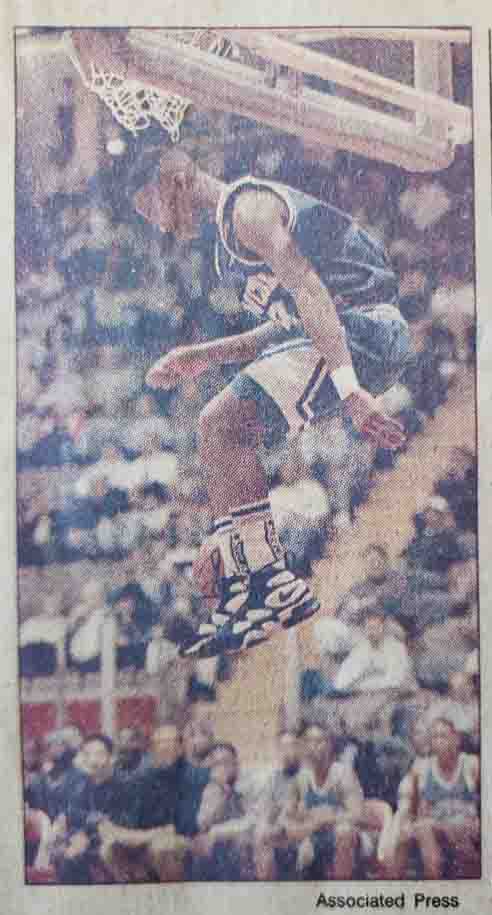
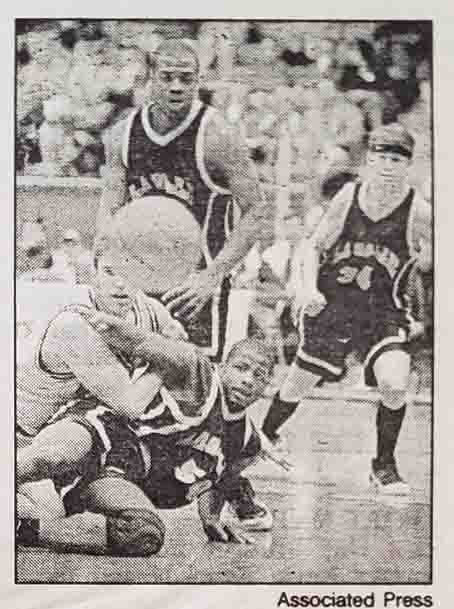
In part one of this two-part interview, Tim discusses his background, how he started playing basketball, and how he became one of the legendary point guards in the LaSalle basketball dynasty. The pictures in this interview come from an archive of Section VI basketball assembled over the years from issues of the Buffalo News, the Rochester Democrat & Chronicle, and Sections V and VI playoff programs by my first Coach at Hutch-Tech High School, Dr. Ken Jones. Other pictures were generously shared by Tim himself, and his Head Coach at LaSalle Senior High School, Pat Monti. Click on any of the images to enlarge them. Links follow up video interviews with Tim, Modie Cox and other LaSalle coaches and players are at the end of this interview.
Anwar Dunbar: First Tim, I want to say that I really appreciate your willingness to talk about your playing days and LaSalle basketball. This really, really means a lot.
Tim Winn: No problem. The older you get, the only thing you’ve got left are your stories.
AD: I’ll tell you a little bit about me and then we’ll jump in. I’m a blogger/writer and a native Western New Yorker just like yourself. One of the things I write about on my blog is success and failure, and my first major success and failure lesson in life was my high school basketball experience at Hutch-Tech in Buffalo. I didn’t go on and do anything as spectacular as you and Jason (Rowe) did, but that was my first time dreaming about doing something, and then feeling some disappointment. That served as a template for the rest of my life also. It’s a story I always wanted to tell, and that’s what I’m doing now.
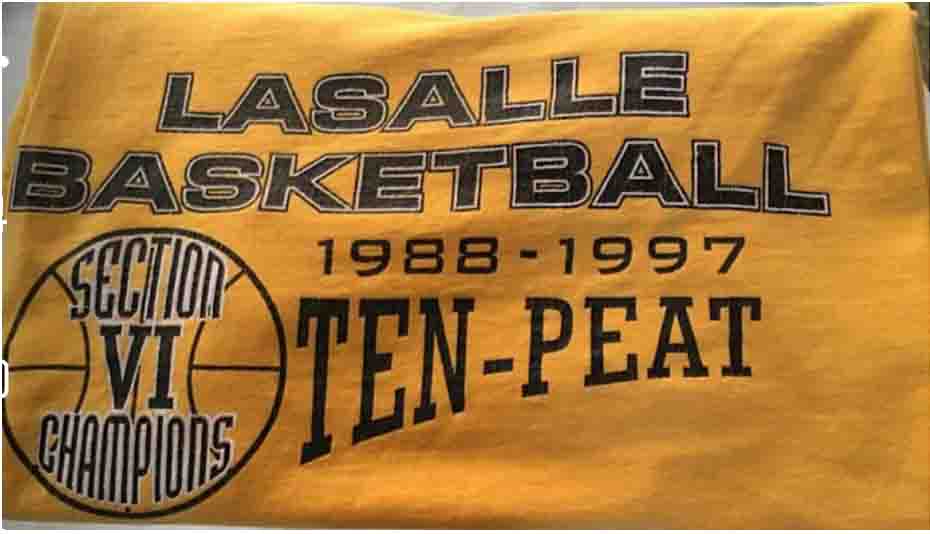
The way that I wrote this up, it’s about my journey, but it also ends up being about Section VI as well, and you can’t tell that story without discussing the power programs – LaSalle, Buffalo Traditional and all of the teams that made their championship runs in that era. Traditional made deep runs in postseason play most years, but your teams at LaSalle were there at the end pretty much every year – for 10 straight years according to what Coach Monti said. Everyone was gunning for you guys so again, it means a lot to be able to talk about the brown and gold.
I’m going to start at the very beginning. While I knew about some of the ballplayers from Niagara Falls in the 1990s, I didn’t know any of you guys personally. Where is your family from?
TW: My grandfather is from Alabama and my grandmother is from Columbia, SC. They migrated up north way back in the day. I grew up on the east side of Niagara Falls.
AD: They came for the industry jobs?
TW: Yes, exactly.
AD: When did you start playing basketball?
TW: I was about five years old. There was a “Biddy Basketball” league in Niagara Falls. They had two age groups – 12 and under and then 12-14 years old. At five years old you were old enough to play.
AD: You know, the first time I heard of the Biddy leagues was in ESPN’s 30 for 30 documentary on Benji Wilson. When Common mentioned it, I had no idea what he was referring to. Were those held at playgrounds or at community centers?
TW: I played for a team called the “Thirteenth Street Center”, but all of the games were held at the Boys and Girls Club in Niagara Falls on Saturday mornings.
AD: Your Dad, uncles, or any older brothers – were they basketball players too?
TW: My Dad was a great athlete. Rumor has it that he could’ve gone pro in football, baseball, or basketball, but he chose the street life – a typical story where we’re from, you know? It ate him up and it never panned out.
AD: So you must have played for your middle school team?
TW: We didn’t do that in Niagara Falls. We played in the Biddy leagues and that was pretty much it. You played for your neighborhood club – the Boys and Girls Club – I played at the Thirteenth Street Center.
There were different community centers throughout Niagara Falls, and you played for the community center within your neighborhood. There are eight or nine different community centers in Niagara Falls that are spread out in the different neighborhoods. The kids migrated to each center, joined the basketball team. There were also games at the Boys and Girls Club.
AD: That’s very different than what we had in Buffalo. Does that mean your middle schools didn’t have teams at all?
TW: Elementary school? No. You either still played in the Biddy leagues or you tried out for one of the Junior Varsity (JV) teams in the sixth or seventh grades.
AD: Okay, I’m just trying to put everything together because your Coach at LaSalle, Pat Monti, shared with me that the LaSalle players were exposed to the program prior to the ninth grade.
TW: I played JV in the seventh grade. When you have a historic program like LaSalle’s with such a rich tradition, the conversation is always amongst you and your peers. How long are you going to play in the Biddy league? When are you going to try out for the JV? It was really common for guys in the seventh grade to go try out for the JV teams. Obviously, everyone wasn’t going to have success, but it was common. The best players in the Biddy league were presented with the opportunity to try out. Coach Monti’s program had been around for a million years for those of us who lived there.
AD: Did you guys have the option of going to LaSalle or Niagara Falls Senior High Schools? How did that work?
TW: It was all based on your address. I lived right next door to someone who went to Niagara Falls High School. The city broke it down in a weird way where it was strictly addressed-based. For me it was the ‘luck of the draw’. If I lived one more house over, it would have been Niagara Falls High School instead of LaSalle.
AD: Which college and professional players did you look up to? Was it Michael Jordan? Was it someone else?
AD: Was it because of his ‘handle’? Was it because he could shoot it as well?
TW: All of it. It was his handle, his competitive nature – just that fight. Where I’m from, if you didn’t’ have that fight in you, you couldn’t play. He was an easy guy to look up to because at his height, you could see his heartbeat before you could see his handle.
AD: Does that mean you guys were taught how to compete early?
TW: Yes. The side of town I’m from – you either competed or your never played. That’s just how it was. It was a really tough environment. The community raised the kids, so you never played with your age group. At five years old, it was common for me to be on the court with guys 10 and 11 years old – it was very common.
AD: How about the college players? Jason said he followed Kenny Anderson, but were you into the UNLV teams, or the Michigan teams, or any players in particular?
TW: No, not at a young age. It sounds crazy, but you looked up to guys in your neighborhood – the guys at LaSalle Senior High School, for example. Basketball was so big in our city that the teams I liked watching the most were the high schools – Niagara Falls and LaSalle.
Modie Cox (pictured) lived right in my neighborhood, just two houses down. He was a hero in my neighborhood. At five and six years old he was the guy that I watched. In terms of the colleges, I didn’t have a favorite team until I got older and then it was Syracuse.
AD: Now were you familiar with any of the other big-time Section VI players like Ritchie Campbell or Marcus Whitfield? Or was Buffalo just that far away a place to the point where your neighborhood was it?
TW: You heard about it, but it was never up close and personal. I remember Ritchie Campbell coming to Niagara Falls to play against Modie in an All-Star game. That was the first time ever seeing him play. I was in awe because he was one of those rare talents that you never see come through your area. From that point it made me pay attention. I wondered, what else was happening in Buffalo? It made you start paying attention to things outside of your neighborhood.
AD: How was Ritchie’s game different than Modie’s?
TW: Modie was a pure point guard – a pure leader, and I thought Ritchie was the kind of player who could just do anything. I don’t think there wasn’t anything Ritchie (pictured) couldn’t do as a basketball player. He could shoot and make it from half court, and his ability to get assists was just as effective. If you needed someone to start your engine and get your car going, Modie was that motor.
AD: I never got to see either of them play, but you always heard of their legends.
TW: They were definitely both legends.
AD: How did you get over to LaSalle?
TW: Again, it was all neighborhood based and I just happened to be one of the lucky kids who lived in that area that sent you to LaSalle and not Niagara Falls High School.
AD: Did Coach Monti start to know you in the seventh grade?
TW: It wasn’t so much that he got to know me. His program was already there and established. A lot of great talent had already come through it. I was in the seventh grade and wanted to give it a shot and try out for the JV. Once I made that JV team, he became familiar with me. It wasn’t really before that. He may have seen me play in the Biddy leagues, but at that age there are a lot of talented kids in Niagara Falls. I pretty much made JV in the seventh grade and it started from there in terms of our relationship.
AD: Was it a big adjustment for you going from the Biddy league to the JV team?
TW: It wasn’t, because I had been playing with older guys all of my life. You grew up getting beat up by Modie Cox, so going to the JV was not that much of a transition. For me it wasn’t a big transition because the JV program was an extension of the Varsity program. It had such a rich tradition that you walked into a ‘well-oiled’ machine.
AD: Now you guys were probably playing Niagara Falls High School’s JV team, but were you also playing against Grand Island, Kenmore East, Kenmore West, and so on?
AD: Who was coaching the JV team? Was it Coach Rotundo?
TW: Yes, it was Coach Frank Rotundo.
AD: So, you played JV in the seventh and eighth grades?
TW: Yes, and in the eighth grade I was called up to the Varsity team.
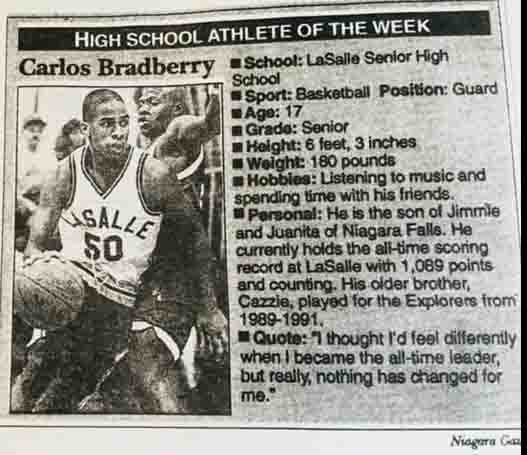
AD: In the eighth grade – how about that. Does that mean you were on the roster when the Carlos Bradberry-led LaSalle team played the John Wallace-led Greece-Athena team in March of 1992 in the Class A Far West Regional?
TW: Yes.
AD: Sweet.
TW: Yes – John Wallace – ‘DA MAN’.
AD: Yes, he had that cut on the back of his head in fat letters. That 1991-92 season was my first year on our Varsity team at Hutch-Tech and you all beat us decisively in the Festival of Lights Tournament. From that point on I kept my eyes on what LaSalle was doing. I taped that Far West Regional game, and I watched it most of the summertime.
I was thinking that the next year I would get to play against Carlos Bradberry, Curtis Ralands, Todd Guetta, Chris Frank, and the rest of the guys on that team. I was sidelined by an injury the next season. We opened up the Festival of Lights Tournament the next season against the Niagara Falls Power Cats and lost to them. We didn’t advance to play you guys anyway, but you always wonder what if.
Once Shino Ellis graduated I thought Jody Crymes – also very talented and lightening quick- would be the next guard up to start alongside Carlos in the backcourt, but suddenly I started hearing about a player named Tim Winn. I was wondering, ‘Who is Tim Winn?’ Describe your freshman season.
TW: It was a rollercoaster ride for me. As you said, Jody was coming into his sophomore year, and with me coming up onto the Varsity team I didn’t know what kind of a role I’d have. I knew that it would be small at first because we had a lot of seniors coming back – Carlos Bradberry was the man. For me, I just wanted to soak it all up, to ‘get in where I fit in,’ as they say.
Coach Monti has a way of just throwing you into the fire. If he’s keeping you on the team, he’s keeping you for a reason. We played Olean High School the first game of that season and I scored 14 points off the bench. To be honest it was a shock to me, because I didn’t think that I was ready on that level to come off the bench and contribute. The opportunity was there, and I took advantage of it.
That was Coach Monti’s genius. He throws you in the fire and expects you to be ready. He allowed you to ‘hide’ behind the system.
AD: Okay, since we’re on Coach Monti, what was it like inside the LaSalle basketball program? I remember you guys played suffocating defense, created a lot of turnovers – a lot of pressing, some zone, and then boom you guys were immediately down at the other basket, laying it up or dunking it.
TW: For me, the blessing was that the program was already established. There was a way of going about your business and there were expectations that the program already had. It also just so happened to meet my skill set somewhere in the middle. It was a ‘no nonsense’ program, and it wasn’t a program where you could just come to practice, roll out the balls and start playing.
Coach Monti is a huge stickler on drills, drills, drills. I learned more at LaSalle than I learned in my whole career when you include college and the pros – just knowing how to play the game. It’s not even close. That experience had me super prepared for anything after that. Coach Monti took the time to teach you how to play, and then he demanded that you play the right way.
AD: What was playing the ‘right’ way for Coach Monti? Was it running his offense? Was it boxing out on defense?
TW: If you didn’t play defense at LaSalle, you didn’t play! His defensive tradition was unreal. It didn’t matter how good you were on offense. It started there. That’s how you win a state championship with four guys my height and a center who was 6’1”. You had to defend – that was the staple of our tradition. We didn’t care who you were playing with or who you had. We were coming in and shutting everything down, and then the offense just fell where it fell.
After the defense it was just being unselfish. You’re a team. We didn’t play for stats. The only stats we cared about was the win. That was our bragging point. If there was any arrogance from us, it was based upon getting victories – not me getting 40 points or Jody Crymes (pictured with Tim) getting 20 assists – it was never about that. Those things just came along with it. If we beat you, then we would walk around with our chests poked out a little bit.
AD: Does that mean no one was looking to get on ESPN (laughing)?
TW: Not at all and this is the thing – when you have so many great teams who have been there before you, you’re not really competing against Western New York. We never came into a season saying, ‘We’ve got to be as good as Buffalo Traditional.’ We were trying to beat history.
I’ll give you a prime example. After Carlos Bradberry’s senior year, we graduated eight or nine seniors. No one gave us a chance to come back the next year, and to do any work. It was the perfect opportunity for guys like me entering my sophomore year, and Jody entering his junior year to take our claim.
We didn’t care about being better than St. Joe’s or Buffalo Traditional! Could we be better than the team we were on last year? The only way you would get props in our city and our program, was if you were one of the best teams within that program, and that was our motivation. Could we be better than Carlos’s team the year before who had the Player of the Year on it? Could we get back to Glens Falls?
For us, Glens Falls was the standard. It wasn’t winning the NFL. It wasn’t winning Section VI. Could you get to Glens Falls and win a State Championship? So when the standards are that and you have complete buy in from all of the players involved, it at least sets you up for an opportunity to come close every year. You’re not satisfied with beating Lew-Port. You could care less about beating Traditional, which was one of the best teams to ever come out of Western New York. I’m just saying that for us, we’ve got to do what we’ve got to do to get to Stephon Marbury and Glens Falls. We were never satisfied with anything local.
AD: Before we move on, what were those guys like – Carlos Bradberry and his class? Did they welcome you on the team? Did they make you have to prove yourself?
TW: We all grew up playing in the Biddy league, so you were already cool with these guys. So the transition to being their teammate on the Varsity was seamless, because we were already like brothers. I lived two houses down from Carlos when I was in high school. Before I became a Varsity player, I was at his house everyday playing video games.
That’s the environment we were in – most of the guys who played Varsity hung out together. You grew up playing against the older kids, and a lot of those guys were the older kids. So to become their teammate was almost expected, and that we would all eventually play together.
AD: What did the LaSalle players do in the offseason? Did you guys go to camps? AAU? What were the guys doing?
TW: It was different for every player. I went away to the “Five Star Camp”, the “Eastern Invitational”, the “Empire State Games“. For me it was different. Jody did a lot of the same, but there was also a league back home that allowed your team to play in it together. We spent a lot of time together playing in high school basketball leagues, but we also played in “Father Bell” as well in Buffalo. We played together a lot.
It’s one thing to stay in your own neighborhood and to compete and succeed, but we also took our show on the road. Once you got to Buffalo in the summertime, and you have guys who may not play together in high school, you might get Jason Rowe and Mark Price on the same team, or Jason and Antoine Sims on the same team. You’re not going to get that staying in Niagara Falls. We felt that if we could find a way to compete against teams that were loaded in the summertime, we knew that we would be better off once the season started.
AD:Coach Monti pointed out that you made the State Tournament all four years which is astounding because, as you remember, many of the Section VI teams were struggling to beat the Section V teams from the Rochester area. When Carlos and his class graduated were you just trying to beat history like you said? What was it like stepping up and doing it yourself 100% of the time?
TW: Do you know what it’s like to get a taste of something? I was young at the time. Me and Jody rode Carlos’s coattails to Glens Falls. As much as we may have contributed, it wasn’t our team. His talent was on a different level. No one in Western New York could deal with him and that carried us.
As a young kid, I didn’t know anything else except going to Glens Falls. We got close to winning the year before, but lost to John Wallace’s team. At worst I thought that I was supposed to be in the Far West Regional against a Rochester team. To beat the Rochester team the next year to go to Glens Falls felt like it was where we were supposed to be. It didn’t take much for Coach Monti to sell us at all. He told us, ‘Look. I’m going to watch the games no matter what. You guys can play well enough to join me or you can stay at home.’
For us it wasn’t a hard sell. Once you get a smell of Glens Falls, there’s nothing else you’d rather have outside of winning it. After riding Carlos’s coattails as a freshman, I wanted my own. The next year I got there as a sophomore and we were immature. No one expected us to be there and the games really took us by storm. We were young kids jumping in the pool at night; just super happy to be in Glens Falls.
The maturity showed up in the offseason because we said, ‘Just going to Glens Falls is kind of whack now.’ Afterwards we were coming to win it and that’s what happened my junior year – to me. If my teammate Terry Rich didn’t get hurt, we would’ve beaten Stephon Marbury’s Lincoln team in the Federation Championship. We didn’t have a full team, but we won the State Championship that year.
AD: So your sophomore year, you guys lost in the state semifinal?
TW: Yes, we lost to a well-coached team with lots of shooters. We were just immature. We finished 22-4.
AD: Talk about matching up with Stephon Marbury in your junior year. He was the No. 1 high school player in the nation that year, right?
TW: You come into it and you know his reputation. You see all of the highlights. He was a McDonald’s All-American, the top point guard in the country. For me there was going to be no better test to let me know what level I was on than to go up against this guy. I was going to try it all. Whoever I thought I was, I was going to try it in that game, and playing against the best, would expose what I needed to work on.
We locked him down. He was averaging 30 points a game, and I think we held him to 12 points. That was a springboard for me in my high school career. I felt like if Stephon Marbury couldn’t score on me, nobody was scoring. I didn’t care who you were. I carried that with me for that entire summer – ABCD Basketball Camp – everywhere I went. It carried into my senior year when we lost two of my favorite players of all time that I played with, Jody Crymes and Terry Rich. Nobody was expecting me to go back to Glens Falls my senior year.
AD: After losing Jody and Terry, how did you reload? Who filled in for them? Or did you just go up another level?
TW: It was a combination of things. For me individually, my game went ten notches up from going to ABCD Camp and playing against the best point guards. I put a lot of work into my game, so I was a lot better than in my junior year.
We also had guys like Roddy Gayle and Carlos Davis who had small roles with us the year before (both pictured to the left). They stepped up big time. For the first time in a long time, it wasn’t just a guard-led team. These guys were my center and my forward even though they were both just 6’. So they really stepped up!
Thank you for taking the time to read this interview. In part two, Tim talks more about playing in the LaSalle basketball program, where he played college basketball, the closing of LaSalle Senior High School, and finally how basketball has changed. If you enjoyed this, you might also enjoy:
I intend to create more promotional/teaser pieces for The Engineers: A Western New York Basketball Story, both via print and video as I journey through the final steps of completing the book. I created a page on Big Words Authors for the purpose of giving a background of the book and grouping all the promotional pieces, such as this in one, for interested readers.
The Big Words LLC Newsletter
For the next phase of my writing journey, I’m starting a monthly newsletter for my writing and video content creation company, the Big Words LLC. In it, I plan to share inspirational words, pieces from this blog and my first blog, and select videos from my four YouTube channels. Finally, I will share updates for my book project The Engineers: A Western New York Basketball Story. Your personal information and privacy will be protected. Click this link and register using the sign-up button at the bottom of the announcement. If there is some issue signing up using the link provided, you can also email me at bwllcnl@gmail.com . Yours in good sports. Best Regards.
Some of the key focuses of my blog are: Financial Literacy, Wealth Building, Business and Entrepreneurship. A significant number of businesses fail within the first five years of their being started – something all entrepreneurs should understand when starting their businesses. To be successful however, each must overcome the fear of their business failing. The following contributed post is thus entitled; Overcoming The Fear of Business Failure.
Ask a would-be entrepreneur why they haven’t started out in business yet, and chances are, you will receive one simple answer.
“I am afraid of failure.”
You don’t need to ask why they are afraid of failure, as this is something many of us feel in varying aspects of our lives. We are afraid of failing in marriage, education, and in our careers, as examples. But if you did ask the would-be entrepreneur why they were afraid of failure, they may answer in this way,
“Statistically, I am destined to fail.”
And this is true, according to statistics, the possibility of failure is relatively high. It’s little wonder, then, that many people don’t risk starting a business, despite the opportunity to escape the rat race of the 9 to 5.
But here’s the thing. While there is the risk of failure, there is also the possibility of success. There needs to be a change in attitude; a shift from fear to courage. Sometimes, the risk is worth it, as business failure is not always on the cards. It’s about turning fearful mindsets around; finding ways to bring a positive outlook to negative thinking.
So, what about you? Do you run a business, or have you taken the decision not to because the fear of failure has gotten the better of you? Aside from statistics, you may not have started out on your own because of the following reasons.
“I’m not good enough.”
Nobody’s perfect, so it’s unlikely you will be good at everything. But you can still improve matters. Look at areas where you are weakest, and rather than let these things undermine the possibility of you succeeding, conquer them. If you suck at all things money-related, hire an accountant or take a money course. Don’t know how to put together a decent business website? Hire a web designer or take HTML Training classes. Whatever your weakness, you can overcome it, whether that’s through outsourcing or building up your skill set. You’re not perfect, but then again, you don’t have to be!
“It’s a one-way ticket to poverty.”
Giving up your full-time job is a risk, so you may not want to begin something that could be a financial disaster. However, there are at least three ways to defeat this. For starters, don’t give up your job just yet. If you are reliant on the income from your career, begin your business, but start slowly. When profits do start coming in, only then consider resigning from your job. Secondly, do all you can to market your business to ensure customers know about you. Focus on branding, send the word out on social media, and broadcast your business in other places online, as well as talking about it to others offline. Lastly, know that many businesses struggle to make a profit within the first year, but this is why it’s important to find ways to cut costs in those early days. Financial wisdom is key, so don’t overspend and don’t splurge your cash reserves on anything you don’t need. This way, you will reduce the risk of financial collapse.
Something to think about.
Here’s something to think about if you do relate to the above. While you may face failure, you might also succeed. Statistically, many businesses don’t fail, so it may not happen to you at all. As we have said, planning is key, focussing on both your skills and your finances. And there are people to help you deal with any area where you may struggle. Surely then, it is worth the risk. You will never get anywhere if you don’t try, and you may later regret it if you don’t. Provided you don’t do anything dumb, there is every possibility that you will make it in business. And if you do screw up? Well, at least you tried, and that’s better than not trying at all.
Are you afraid of starting your own business? Consider our advice and think again. It may be a wise decision not to start out on your own, but then again, it could be the best decision you will ever make!
Some of the key focuses of my blog are Financial Literacy, Wealth Building, Business and Entrepreneurship. Many businesses and services involve the use of uniforms as a form of branding and image. The following contributed post is thus entitled, Why Have A Company Uniform?
Company uniforms can have a number of benefits. Here are just a few reasons to consider adopting a uniform for your business.
It can make you look more professional
Uniforms can ensure that you and all your staff keep up a professional appearance. Whilst some companies like to introduce a dress code, it’s often easy to bend the rules – the line between smart and casual can easily be blurred. With a dress code there’s little leeway to do this and you can have more control over the level of formality.
It promotes equality
By making your employees dress the same way, you can help to build a sense of equality and unity. Fashion after all can sometimes create a social hierarchy with people judging each other based on dress sense. Having a uniform forces everyone to be on the same level creating a greater sense of equality.
It can save employees money
By having to wear a uniform, employees won’t feel as pressured to dress differently each day and therefore won’t feel the need to keep buying as many clothes. This could save your employees money in some cases. When supplying a uniform, make sure that it is free for your employees – you should only ever charge money if somebody keeps losing part of their uniform.
You can use it to promote your brand
A uniform can be a good form of branding in some cases. You can look into making your own shirt with a company logo on it. Other options could include branded overalls, branded blazers or branded aprons. Branding will help to build awareness of your company and add to your overall brand consistency. It could even be a form of advertising, helping to bring in new business.
It can help clients identify staff
If everyone is dressing in casual clothes, it can sometimes be difficult for clients to identify who is a staff member and who isn’t. A uniform makes it easier to immediately tell who is staff and who is a customer. You can also use varying colours or designs to single out management staff so that customers who want to speak to someone higher know who to talk to.
It can be used to enforce health and safety
In some jobs, a uniform could also be used to help enforce health and safety. The most obvious example of this is the construction trade in which hard hats, hi-vis jackets and gloves all help to protect staff members from harm. Uniforms can have a similar function in other roles – in medical and cooking roles, short sleeves are now often favoured because they don’t get in the way. Consider ways in which you could integrate health and safety into your uniform.
If you take a look at workers compensation laws, you will see that PPE is something that is discussed a lot. A lack of PPE is one of the main reasons for injuries and subsequent compensation claims. Of course, if a worker has failed to use PPE in the way they are directed to, the fault would then fall onto their shoulders. Nevertheless, it is critical to understand how uniform plays a key role in terms of health and safety.
Some of the key focuses of my blog are: Financial Literacy, Wealth Building, Business and Entrepreneurship. A key aspect of starting a successful business is ‘Branding’. The following contributed post is thus titled; Five Branding Decisions Every Startup Needs to Make.
* * *
If you are thinking about going out in the big world and starting your own company, you will need to get the market positioning right, or you will never make it in the competitive world of commerce. No matter which industry you are dipping your toes into, you will need to make some important branding decisions so you can communicate what you offer and what your company is about. We will cover five of them below.
One of the first things you should decide on is your business name. You might choose something catchy, unique, or creative, but make sure that you create a name search to make sure that there are no other companies using the same name, or you can get into legal trouble. For more information, check out https://www.qdosaccounting.com/choosing-right-company-name/ so you can make the right branding decision.
Once you have the business name registered, you will have to make sure that you are getting a logo and a website designed. However, you might not want to rush into the decision. In fact, an average college student could put together a good looking website. What really matters is how you engage with your online audience and how many customers your website generates automatically. You might be better off finding a local marketing expert who can take care of your design and branding at the same time.
3. Color Schemes
Once you have your logo, you will have to use the same colors throughout your site and your business literature. You might want to create leaflets, cards, and online banners for your social media sites that match the rest of your brand image and delivers a consistent message to your visitors.
4. Slogan
Without a slogan, your customers will have a hard time working out what your business is about and what you are offering. Many small business owners neglect the importance of a good business slogan. Your slogan will stick in your potential customers’ head. You might want to learn some branding tips from the big companies. We all remember Nike and McDonald’s, because they keep on repeating the same brand messages.
5. Mission, Vision, and Value Statement
If you would like to increase your brand value and connect with your potential buyers on an emotional level, you will have to find a way to communicate what you stand for and align your values with your market’s. While this requires a bit of research, if you get it right, you will be able to strengthen your brand’s reputation and attract the right clients to your business. You need to display your mission, vision, and value statement on your professional business literature, website, and it needs to be communicated through every piece of content you produce.
To start your company the right way, you will have to make some challenging branding decisions. If you get them right, you can create meaningful connections with your target market and increase your brand recognition fast.
Two of the focuses of my blog are Financial Literacy and Money. A key aspect of one’s financial health is controlling and minimizing debt. The following contributed post is thus titled; Breaking Free From The Shackles of Debt.
If you’re in debt then life can start to feel quite gloomy, indeed, having a huge amount of debt can sometimes make people feel trapped like they are a prisoner confined in a prison where they are emotionally paying for what they might feel they have done ‘wrong’.
Yet, debt isn’t as dirty a word as some people feel it is, it doesn’t make you a bad person, and it doesn’t even mean you are necessarily irresponsible. Life is unpredictable and we’re all just a few twists and turns away from being in financial trouble… the greatest challenge is the fact debt is often a slippery slope where one or two missed payments suddenly mount up, and escalate to the point things start snowballing out of control.
The worst thing, though often the most natural thing to do in such circumstances, is to bury your head in the sand. The challenge here is that this is the time you need most to take control and get a handle on the situation.
If your financial situation has snowballed out of control then all is not lost; even if you feel on the brink of despair in most western countries the option to declare bankruptcy exists, meaning you can have a second chance to get things back on track.
People often over complicate the process of breaking free from the shackles of debt as their emotions take over their logical thinking, in psychology this is known as an amygdala hijack where essentially the brain goes into survival mode, and when feeling such intense financial stress, a common response is to bury one’s head in the sand.
The greater challenge, however, is that people in debt often focus on the “debt” as almost a definition of who they are, it’s as if being in debt becomes their identity, and this is dangerous as what we focus on the most we become.
If we liken this to being a prisoner trapped in debt, it’s like looking down at the shackles around your feet, focusing on how trapped and impotent you feel to change the circumstances you’ve found yourself in – yet, it’s only when you stop focusing on the shackles around your feet, start looking up, and shifting your focus that you can get out of debt.
See, the fuel you require to get out of debt is money, as this is the source of freedom in that having money is the only thing that will help you break free from the shackles of debt – whether that’s in the form of a consolidation loan from The Ascent or by earning an extra income through business or employment activities.
When you are focused on the shackles of debt, your attention is not focused on doing the thing that is required to break free – therefore, the predominant thing you need to do to “break free” from debt is to stop focusing on the debt and start focusing on taking the required action to get out of debt.
Some of the key focuses of my blog are: Financial Literacy, Wealth Building, Business and Entrepreneurship. Many Entrepreneurs start off as Small Business Owners and a key aspect of starting a successful business is ‘Branding’. The following contributed post is thus a Small Business Branding Guide.
* * *
It does not matter what sort of business you run, or how big or small it is, branding is pivotal. If you are to stand out from the crowd and achieve your business goals, you need to brand effectively. With that being said, read on to discover the steps that small businesses need to follow when branding their company.
Put together a budget – The first thing you need to do is determine how much money you have available for your branding budget. A lot of business owners look into lending options for this, as branding is such a pivotal aspect of their company. Head to https://smallbusinessloans.co/ for some more information on this. Either way, it is vital that you know exactly how much money you have available.
Begin by defining your brand – What marketspace do you occupy? You can’t do anything in terms of branding until you define your brand.
Business driver – What drives your company? What is the purpose of your business? Who are your heroes? All of this needs to be considered carefully so that your brand has the right direction.
Think of your brand as a person – This can really help you in terms of making your brand feel like a tangible being, which people can relate to. If your brand was a person what would it be like?
It’s more than your logo – One of the biggest mistakes that a lot of business owners make is assuming that their logo is their brand. This is a minute part of your brand. Yes, it is a vital part of it, but there is so much more to branding than merely slapping your logo everywhere.
Don’t copy – Yes, you can seek inspiration from the big brands, but you should never merely copy what other companies are doing. Not only could you end up with a lawsuit on your hands, but you need to have your own identity if you are going to have a strong business presence. The last thing you want to do is make it appear like you are simply a cheap copy of what is already out there.
If you follow the advice that has been presented above, you should be able to establish a strong brand image for your business. As a small business owner, this is imperative if you are to grow your business to the level you hope to.
Two of the main focuses of my blog are Financial Literacy and Money. The following contributed post was written by Faye McDonald. It discusses The Three Biggest Sources of Money Stress.
* * *
Most of us have felt it at some point or another. When you’re facing money trouble, stress becomes a real factor in your life. It can affect your sleep, your work, your relationships, and even your health. Here, we’re going to look at some of the biggest sources of money stress and what you can do about them. After all, the impact of money troubles goes a lot further than your bank account.
Income
A lot of importance is put on getting a job with a good income. It’s true that if your paycheque is big, you’ll have an easier time managing all your costs and putting together savings for your future. However, while working on your career should be a focus, it shouldn’t be the only one. There are other paths to take to financial security and prosperity. It’s all about planning better with what you have. By creating a budget, it’s easy to find the little extra savings that you can contribute to long-term goals. These investments from Profitable Venture show that you can even start contributing them to strategies that can see them playing a part in growing your wealth outside of your job. Investments allow you to diversify not only your income but also your reserves for retirement and bigger investments in the future.
Debt
The fear of debt is often a lot worse than debt, itself. There are a lot of different strategies to try and handle it. None of them involve ignoring the problem and hoping you don’t get noticed, which is unfortunately what most people in a panic tend to do. There are options to help control it like debt consolidation loans from Buddy Loans, but you should always try talking to your creditors first and foremost. If you begin to suspect you will have trouble repaying your debts to the letter of the agreement, you may be able to negotiate it with them. You might not always have your debt reduced, but you can get your repayments restructured. Most creditors don’t want to have to turn to collectors just as much as you want to avoid them.
Insecurity
If you’re living on a low income, one of the biggest fears might be the risk that an unexpected cost could bring with it. If you suddenly have to pay for major car repairs, would it put you in debt? Besides insurance, building an emergency fund is one of the best ways to ensure that you at least have some safety nets to stop you from going into freefall. Contribute a little bit of your income every month towards a fund that can cover all of your expenses lasting three-to-five months. That way it can cover not only unexpected costs but some of the danger of being put out of employment, too.
Don’t forget that there are resources like the Money Advice Service that you can turn to when you can’t see any options that can help your financial situation. It’s easy to feel like you’re stuck in a downward spiral, but if you’re not a financial expert, there may be solutions and plans that you haven’t considered.