Boosting Your Career Through Continuous Learning

My blog focuses on Career Discussions and General Education. One of the keys to being successful in your career or in any station in life is continuing to learn. Continuing to learn will continue open doors for you. The following contributed post is entitled, Boosting Your Career Through Continuous Learning.

* * *

Image Credit: Unsplash

Thinking that you finish your education and then just work for the rest of your life is an old-fashioned idea. In today’s fast-changing job market, staying relevant and moving ahead in your career means you have to keep learning and growing, both personally and professionally.

When you commit to continuous learning, it’s not just about adding something to your resume; it’s about building a career that’s strong, flexible, and rewarding.

Why Learning Never Stops

The world of work is always changing. New technologies pop up, industries shift, and job roles transform. Skills that were important five years ago might not be as critical today, and totally new skills are now in high demand. Because things change so quickly, learning throughout your life isn’t just an option anymore; it’s crucial for your career to survive and grow.

Adopting this mindset helps you stay current, making you a more valuable employee where you are now and more appealing to future employers. It’s more than just playing defense; understanding the benefits of continuous learning shows it can also rekindle your passion for your field, boost your confidence, and open doors to opportunities you might not have thought about before.

Identifying In-Demand Skills

With so many ways to learn, it’s smart to be strategic. You don’t need to learn everything, just the things that will make the biggest difference to your career goals. Start by looking at job descriptions for roles you hope to have in the next two to five years. What skills, software, or certifications keep showing up?

Another good approach is to look closely at your own industry. Read trade magazines, follow experts on professional networking sites, and pay attention to what’s being discussed at industry conferences. These are great sources for information about current trends and where things are headed. You can also ask a mentor or your manager for feedback on any skill gaps you could fill to do better in your current job.

Formal vs. Informal Education Paths

Once you know what to learn, you need to figure out how. Your choices usually fall into two groups: formal and informal education.

Formal Education includes university degrees, college diplomas, and professional certifications. These paths are structured, follow a clear plan, and lead to a recognized qualification. They’re great if you want to make a big career change or enter a field that requires specific credentials.
Informal Education is more about learning on your own. This includes reading books, taking short online courses, watching tutorials, listening to podcasts, and learning from projects at work. This way of learning is flexible, often cheap, and lets you pick up specific skills quickly.
Often, the best approach uses a mix of both. You might go for an official certification (formal) while also keeping up with industry blogs and podcasts (informal) to stay current.

Applying New Skills to Find Better Jobs

Learning new skills is only part of it; you also need to show them off effectively to move forward in your career. Start by updating your resume and professional profiles to include your new qualifications. Don’t just list a skill; give a short example of how you’ve used it. If you completed a project as part of your learning, think about creating a small portfolio to show what you can do.

With your updated credentials, you can start looking for new opportunities. This might mean applying for a promotion internally or a new role within your company. It could also mean looking outside for jobs that better fit your new skills and career goals. Actively searching for jobs helps you see how your new skills are valued in the wider market and can lead to big career advancements.

Measuring Your Learning ROI

How do you know if spending time on learning is worth it? The return on investment (ROI) isn’t always a direct pay raise, though that’s a common and welcome result. It’s important to look at your returns in both clear and less obvious ways.

Clear returns are easy to spot: a promotion, a raise, or a new job offer with better pay. Less obvious returns are just as valuable. Do you feel more confident in meetings? Can you finish tasks more efficiently? Has your new knowledge helped you build stronger relationships with colleagues or clients? These are all good signs that your learning is making a difference. To get the most out of your efforts, it’s important to find a way to make it a habit rather than treating it as a one-time thing.

Your career isn’t a fixed destination; it’s a journey that keeps going. By continuously investing in your own skills and knowledge, you empower yourself to not just keep up with change but to lead the way in your professional life.


What Is a Convent School and How Does It Work?

My blog focuses on General Education. There are several classes of school young people can attend, and one class is convent schools. The following contributed post is entitled, What Is a Convent School and How Does It Work?

* * *

A child’s education is an important one to think about, especially when it comes to them entering an institution at school age.
When choosing a school, it’s good to do your research on the type of schools available and which ones within your local area are perhaps considered the most influential/popular amongst families within the community.

Convent schools are a type of educational institution that is worth considering if it’s available nearby to you.

Image Source

What’s a Convent School?

A convent school is an educational institution that’s operated by a Catholic religious order of sisters or nuns. It focuses on academic excellence, providing moral discipline and spiritual growth.

Typically designed for students from pre-kindergarten through high school. These schools have been historically rooted in providing education for girls. It emphasises a holistic approach to education and combines traditional academics with religious and character-based values.

How Does it Work?

Wondering how a convent school works? There are a number of characteristics that make up this type of school.

When it comes to education, convent schools are recognized for high levels of discipline and structure. These are schools that instill habits of responsibility, consistency and punctuality.

If you’re looking to prepare your child for demanding professions in the future, then a convent school is well worth considering for your child.

Alongside high academic standards that are similar to some of the best secondary schools out there, they also integrate Catholic Gospel values. This includes community service, integrity and compassion, all within the everyday learning environment.

Historically, many of these convent schools were founded and managed by nuns in order to keep independence in teaching. It would focus mainly on secondary education for girls. In many areas where these schools exist, they’re now under government inspection, ensuring academic standards are maintained.

Convent schools have evolved over the years, especially in places like India, where they incorporate creative and student-centric learning methods. They achieve this whilst also maintaining their reputation for academic rigor.

Though many of these schools are co-educational, many convent schools historically and currently focus on girls’ education and are often in boarding settings.

The atmosphere created with these schools is designed to offer a sense of community, with many students and families seeing it as being it’s own family unit. This might be appealing to those who want a home away from home when attending school.

Reasons Why You Wouldn’t Choose A Convent School

There are some reasons why parents wouldn’t choose a convent school. The most obvious reason being that the beliefs that this school has aren’t ones that align with or are believed by the parents or children.

Some of these schools are known for having quite strict discipline, which may not be the best match for some types of students.

You must be selecting the best school for your child or children, so weigh up the pros and cons of convent schools before applying to one.

Overcome Self-Doubt and Build Lasting Confidence in Learning and Life

My blog focuses on General Education. A major key to education is building confidence no matter what field you have chosen to study. The following guest post is entitled, Overcome Self-Doubt and Build Lasting Confidence in Learning and Life.

* * *

African American adult learners returning to school, stepping into STEM programs, or moving into new roles often carry a quiet question: “Do I really belong here?” That pressure can look like imposter syndrome, a pattern where real effort and real wins still feel like luck, and every mistake feels like proof. Common symptoms of imposter syndrome include over-preparing, downplaying achievements, fearing feedback, and feeling exposed in classrooms or at work. These psychological barriers are not just personal; the cultural impact on confidence, stereotypes, and being “the only one” can make self-doubt in education and career feel constant. Naming the doubt creates a clearer starting point.

Understanding Imposter Syndrome and Your Triggers

Imposter syndrome is the feeling that you’re a fraud, despite evidence of your success. It often shows up as over-preparing, minimizing your wins, avoiding feedback, or thinking one mistake “proves” you are not cut out for this.

It can get louder when you enter a new space with new rules, like a STEM cohort, a promotion, or a structured business-management pathway with grades, metrics, and constant evaluation. For many African American adult learners, extra visibility or being “the first” can make normal learning bumps feel like personal failure.

Picture starting a new job while taking night classes and learning budgeting at the same time. A tough quiz or a tense meeting triggers the urge to hide, hustle harder, or dismiss your progress as luck.

Once you can name your triggers, you can start replacing them with self-compassion and practical reframes while working toward a bachelor’s degree in business management.

Use 6 Practical Strategies to Shrink Imposter Thoughts

Imposter thoughts get louder when you’re triggered, new classrooms, new roles, higher stakes, or being “the only one” in a space. Use these six strategies to lower the volume and respond on purpose instead of reacting on autopilot.

1. Practice self-compassion in a 60-second reset: When you notice a trigger (a tough exam, a meeting where you feel behind), pause and name what’s happening: “I’m having the thought that I don’t belong.” Then try a quick self-compassion exercise: place a hand on your chest, take three slow breaths, and ask, “What would I say to a friend in my exact situation?” This works because it interrupts shame and helps your brain shift from threat-mode back into problem-solving.

2. Use a CBT-style “thought receipt” to challenge the story: Write the thought down exactly as it shows up (example: “I got lucky; I’m not really good at math”). Next to it, list three pieces of evidence for and three against, including real data like grades improving, projects completed, or feedback from a supervisor. Replace the original thought with a balanced one: “I’m still learning, and I’ve earned my progress through practice.” Doing this trains you to separate feelings from facts.

3. Turn wins into proof with a weekly “evidence log”: Imposter syndrome thrives on selective memory, only the mistakes stick. Once a week (10 minutes), record 5 concrete wins: a chapter finished, a budget category finally under control, a lab report turned in, a scholarship application submitted. Add one sentence for each win: “What skill did this take?” Over time, this becomes a personal record you can reread before interviews, exams, and big presentations.

4. Build a “people plan” before you need it: Choose two support roles: one person who encourages you and one who gives honest, skill-building feedback. Be specific in your ask: “Can I text you after my exam to reality-check my self-talk?” or “Can we do a 20-minute study check-in on Sundays?” For adult learners balancing work and family, this reduces isolation and makes your growth visible to someone besides you.

5. Swap fixed labels for growth-minded language: Catch identity statements like “I’m not a STEM person” or “I’m bad with money” and rewrite them as process statements: “I’m building my STEM skills” or “I’m learning my spending triggers.” The habit of speaking kinder words matters because your brain treats repeated language as instructions, what you rehearse becomes what you reach for under stress.

6. Know when to get professional support, and what to ask for: If imposter thoughts are affecting sleep, causing panic, or keeping you from applying for programs, promotions, or financial opportunities, consider talking with a counselor, therapist, coach, or a campus/community mental health provider. Ask directly for help with cognitive reframing, anxiety skills, and confidence-building routines. Getting support isn’t “proof you can’t handle it”, it’s a strategy to protect your goals.

Used consistently, these strategies help you respond to triggers with steady, repeatable actions, so confidence grows from what you do every day, not from waiting until you “feel ready.”

Daily and Weekly Rituals That Build Real Confidence

    Confidence grows when your routines match your goals, even on tired days. For adult learners building education and money skills in an African American cultural context, these habits turn self-respect, community wisdom, and steady practice into proof you can trust.

    Two-Line Morning Affirmation

    What it is: Write two affirmations: one for learning, one for money choices.
    How often: Daily
    Why it helps: It sets your inner voice before the day tries to set it.

    Three-Point Micro-Goal Plan

    What it is: Choose one study step, one life step, and one financial step.
    How often: Daily
    Why it helps: Small wins stack into visible progress you can measure.

    “Instead of, Try Thinking” Reframe

    What it is: Use an instead of, try thinking swap when negative talk shows up.
    How often: As needed
    Why it helps: It replaces shame with a next step you can act on.

    10-Minute Reflection and Receipt

    What it is: Journal one doubt, one fact, and one action you will take.
    How often: Weekly
    Why it helps: It trains you to lead with evidence, not fear.

    Community Check-In Text

    ● What it is: Send a quick update to one trusted person and ask for accountability.
    ● How often: Weekly
    ● Why it helps: Being witnessed makes follow-through more consistent.

    Pick one habit this week, then tailor it to your household rhythm.

    Common Questions About Imposter Feelings

    Q: What are some common signs that I might be experiencing imposter syndrome?
    A: You may dismiss compliments, over-prepare to avoid being “found out,” or feel your success was luck instead of skill. You might also compare yourself to people with different support, time, or access and conclude you do not belong. Knowing the imposter syndrome definition can help you name the pattern without shame.

    Q: How can I start challenging negative thoughts that fuel feelings of self-doubt?
    A: Treat the thought like a claim and ask, “What is the evidence, and what is the next step?” Write one proof point, such as a quiz score, budget win, or class attendance streak, then choose a 10-minute action. Keep a “wins” document with dates and results so you can reread it when anxiety gets loud.

    Q: What role does self-compassion play in overcoming imposter syndrome?
    A: Self-compassion helps you recover faster after mistakes, which keeps you practicing instead of hiding. Speak to yourself the way you would to a respected elder, cousin, or classmate: honest, but not harsh. Try one sentence: “I can be learning and still be worthy.”

    Q: How can embracing imperfection and continuous learning help reduce feelings of inadequacy?
    A: Imperfection is feedback, not a verdict, so you stay focused on growth rather than image. Set “progress metrics” like hours studied, modules completed, or bills tracked, not perfection metrics like never struggling. Save your wins document as a simple PDF so you can revisit it before tests, interviews, or money decisions, and for organizing your achievements and study notes, worth a look.

    Q: How can someone struggling with imposter syndrome find guidance or support from financial literacy resources?
    A: Start with resources that teach one skill at a time, such as budgeting, credit basics, or negotiating bills, and pair them with a weekly check-in buddy. Bring a specific question to community workshops or trusted educators and practice self-advocacy: “Can you show me an example and let me try?” Remember how common this is, since 62% reflects how many people may struggle with imposter feelings.

    Turn Imposter Feelings Into Steady Confidence and Growth

    Self-doubt can show up even when the work is real, especially in demanding classrooms, labs, and career spaces, making it easy to second-guess belonging and ability. Overcoming imposter syndrome comes from practicing a steady, evidence-based mindset: name the story, anchor to facts, and keep returning to what has already been earned. When this approach becomes routine, building self-confidence stops depending on praise and starts resting on progress, preparation, and documented wins. Confidence grows when evidence speaks louder than doubt. Choose one strategy today, review the “wins” document before a class, interview, or study session, and commit to doing it for one week. That small habit supports empowerment in education and career, protecting long-term personal growth and

    How Black History Has Shaped Our World

    My blog focuses on General Education and Black History. Many ethnic groups have made contributions to society. Black History has been a key component of the world as we know it. The following contributed post is entitled, How Black History Has Shaped Our World.

    * * *

    Black history is not a side note in the story of society. It is woven into the foundations of law, culture, politics, business, and everyday life. Too often, though, it gets reduced to a handful of famous names or a single month on the calendar. The truth is far richer and far more complex. It is a history shaped by struggle, courage, innovation, leadership, and an ongoing push for fairness and equality.

    When you look at history through a legal lens, you begin to see just how much has changed over time. Laws that once excluded and discriminated have been challenged and overturned. Courtrooms that once denied opportunity have slowly opened their doors wider. None of that progress happened by accident. It happened because individuals and communities demanded justice, stood firm in the face of resistance, and worked tirelessly to reshape the systems around them.

    Milestones in Black history are not just symbolic moments. They represent real shifts in power, access, and representation. Each breakthrough builds on the ones that came before it, creating momentum that carries forward into future generations.

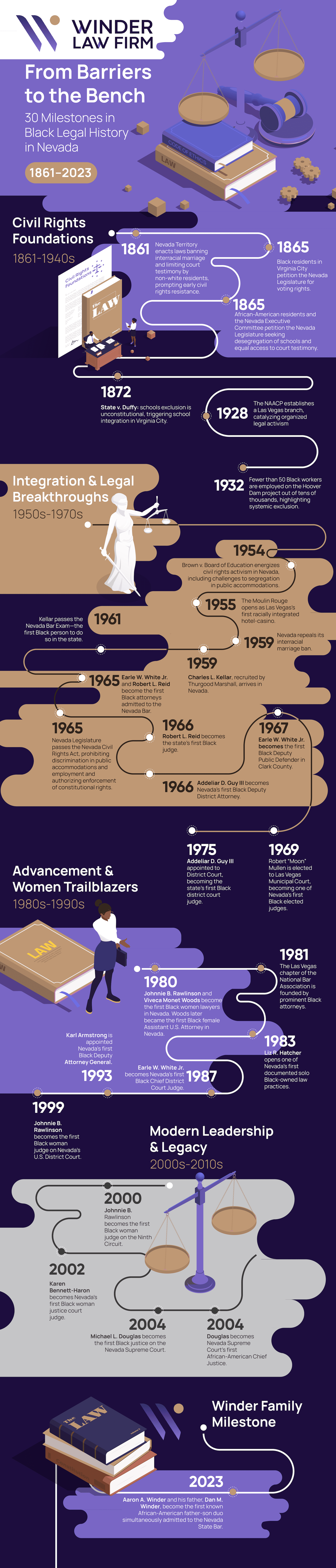
    This infographic highlights key moments and achievements that reflect that journey. By laying them out clearly and visually, it helps connect the dots between past and present. Take a moment to explore it below and see how these defining moments continue to shape the world we live in today.


    Infographic by the Winder Law Firm

    Big Words and Some of My Own Personal Black History: Reflections on Education, Perception, Social Class and Station in Life

    “Your father talks like he’s from BOSTON, not New York City!”

    Big Words, Black History Month and Blackness

    Who is black and who isn’t? Who decides? And what can you tell about a person by the way they communicate and conduct themselves? “Why do you use those big words all the time Anwar?” I wanted to revisit my concept of ‘Big Words’ for Black History Month 2026. My initial offerings for The Examiner and The Big Words Blog Site were an essay highlighting a question I got in middle school regarding my verbal usage of the English language. It is a true story, and it was a foundational experience in my life. It was one of the first lessons in social class and understanding that there are different tribes in what we call Black America. In this instance, the lesson was there were homes where education and intellectual curiosity were encouraged and there were homes where they weren’t. This form of nurturing also dictated the manner in which many of our ‘kinfolk’ related to one another and which doors opened and closed for us later in life, personally and professionally.

    How We Sound to Others Matters

    “Your father sounds like he’s from BOSTON, not New York City!” My father and his second wife had an interesting relationship. They weren’t equally yoked in terms of education and that manifested in certain ways that surprised me. Her writing skills, or lack thereof, was off-putting to him as they had different levels of education. He had his master’s degree and she didn’t finish college. My stepmother likewise joked often that Dad talked like he was from Boston and not his native New York City. She always laughed hard when she told this joke which tickled me as well when she told it. I likewise enjoyed imitating my father’s deliberate, methodical and particular speech with his signature mannerisms. It always made my brother laugh as well.

    There are, in fact, Boston and New York accents for most of the residents of those urban areas. There is also a Washington DC-Maryland accent which is most notably spoken by the native black residents. There is also a Canadian accent if you ever get to meet people from southern Ontario like I have. I’m saying this to say that I think that my stepmother wasn’t referring to the Boston accent per se, but instead, my father’s very specific diction and proper usage of words. Again, I laugh too when she tells the story because I know exactly to what she’s referring.

    Reflections on Big Words, Black History and Social Class

    Going back to the concept of Big Words and Black History Month, again being asked why I used big words in elementary school was a foundational experience for me. It is also one that has impacted my entire life as it is a common experience in Black America, one depicted in movies like Glory where Denzel Washington’s character, Trip, mocked the late Andre Braugher’s character, Thomas, because he could read and speak the ‘King’s English’. It was an early experience demonstrating that we form opinions of one another by how we talk, which is another part of the legacy of Black History.

    My mother’s family were jokingly considered to be like the Kennedy family in the Jasper Parrish Projects in Buffalo where they grew up because my grandmother encouraged education, and they all exuded a certain amount of class. Throughout my life, I’ve been told that I’m proper, bougie and, in some instances, I’ve been told that I seem like the type of guy who likes to live around white people. Similar things have been said to me regarding liking white women. The comments surprised me at the time, but now I get it and am at peace with it. Regarding the last two assumptions, I think I like being and going where I’m accepted and celebrated regardless of color.

    Those of us who pursued higher education also note how lesser educated people speak, and thus, it’s a door that swings both ways. The same goes for how we write. As with many parts of life, you can’t judge a book by looking at the cover as they say, and sometimes how a person communicates and carries themselves tells you some things about them, but it doesn’t tell you everything about them.

    Closing Thoughts

    I did not want to make this essay too long. I’m in awe sometimes though at how that conversation from middle school has continued and translated into my adult world. How about you? Have you experienced something like this in your own life regardless of your level of education or if you’re from a different ethnic group? Let me know in the comments section of this blog post and thank you for reading this.

    The Engineers: A Western New York Basketball Story Part One is available in the eBook, Hardcover and Paperback Editions

    Writing a book was the genesis of my blogging and becoming a video content creator. I have published part one of my book project entitled, The Engineers: A Western New York Basketball Story. It is currently available on Amazon in eBook, hardcover, and paperback formats. The paperback format is available on IngramSpark, and signed hardcover and paperback copies on my online store entitled Big Words Authors via credit payment. Payment using Cash App, PayPal, Venmo and Zelle is also available. Reach out to me for further details. Finally visit the page discussing the book. Please consider visiting it to learn more about the project and see promotional content I’ve created surrounding the project.

    Progressing your Career within the Healthcare Sector

    My blog focuses on Career Discussions and General Education. The Healthcare sector is one that will likely never go away. Once you’re in though, you want to continue advancing. The following contributed post is entitled, Progressing your Career within the Healthcare Sector.

    * * *

    Do you feel as though your career has stagnated over the years? Maybe you feel as though you aren’t getting anywhere, but you want to find out the reason why, so you can make a positive change. Either way, this guide will show you what steps you can take to try to make sure that you are getting the result you want out of your job.

    Source: Pexels

    Find a Mentor

    The first thing you need to do is try to find a mentor who can talk you through the process. Finding a mentor in any sector might not be an easy task, but at the end of the day, if you can shadow them, then you will be able to go through their daily tasks as well as find out what the job entails. You can also find out if you believe you are a good fit for the role, which is essential. It can also help you to answer several questions about yourself and what you might be looking for in a role. Mentors are there to support you and all of your career endeavors, so relying on them is one of the best things you can do.

    Get Yourself Out There

    Getting yourself out there is so important. Whether you want to try and get an internal promotion or whether you want to try and get an offer from another facility, you need to work to try and get yourself out there so you can make the situation you are in. Getting yourself out there can be hard, but if you can take the time to go through everything, this will make it easier for you to get the result you need.

    Undertake Training

    Another thing you need to do is try to undertake training, if you can. Getting a ms public health online is one of the best things you can do if you want to get somewhere. This will open up a lot of doors for you, and it will also allow you to carry on working the job you have now, so you don’t have to stop earning, and you can attend university. Things like this can help you progress, and you would be surprised at how much it could help you to not only move forward, but also do so at a pace that reflects higher earnings at a later date. If you are unsure as to which qualification you should undertake, then one thing you can do is go through all of the roles you would love to work in, and then assess the career requirements for those roles. If you can do this, then you will see a notable improvement in your career potential, and you will also find it much easier to feel comfortable and content in the roles you are pursuing.

    So as you can see, progressing within the healthcare sector is relatively easy to do, and if you follow this guide, you will find it easier to move forward with confidence.

    Is Your Laptop Helping You Study or Just Holding You Back?

    My blog focuses on General Education and Technology. Laptop computers are like any tool in the tool drawer. They can be valuable if put to good use, or they can be used for less productive things. The following contributed post is entitled, Is Your Laptop Helping You Study or Just Holding You Back?

    * * *

    For many students, a laptop feels like the single most important tool when it comes to studying, but it can be both a blessing and a burden. It holds notes, textbooks, apps, and everything that makes learning easier, but it’s also the same device that hosts streaming platforms, social media, and endless distractions.

    Finding balance is the real challenge, and it’s one that almost every student faces at some point. The question isn’t just about whether a laptop is necessary, but whether it’s being used in a way that actually supports learning rather than slowing it down.

    Source: Unsplash (CC0)

    The positives of using a laptop for studying

    Laptops make studying more accessible than ever before. Instead of carrying heavy books and stacks of papers, students can have everything organized in one lightweight device. Having access to research tools, writing software, and online learning platforms saves time and makes learning feel more connected as well.

    There’s also the advantage of mobility. With a laptop, you can study from a library, cafe, or even a park, making it easier to find laptop-friendly places that encourage focus. This flexibility helps turn any space into a temporary study spot without losing access to important materials.

    The challenges of staying focused

    While laptops provide all the tools needed to succeed, they also carry endless temptations that can interfere with progress. Notifications, social media feeds, and entertainment are always only a click away, and without discipline, it’s easy to lose track of time. This can lead to late nights spent scrolling instead of finishing assignments.

    One way to reduce distractions is to create boundaries. Turning off notifications, using website blockers, or even keeping a separate browser just for study tasks can make a big difference. These small adjustments help keep focus on the work that actually matters.

    Making the most of study environments

    The place where someone studies can be just as important as the laptop itself. A quiet, well-lit space can encourage focus, while a noisy or crowded area can make it harder to concentrate.

    This becomes even more important especially if you’re studying abroad, since the environment is often unfamiliar. Taking the time to explore different study locations can help find the ones that feel comfortable and supportive of good habits. When the setting feels right, studying on a laptop becomes far more productive.

    Finding balance in digital study habits

    The goal isn’t to avoid laptops but to use them wisely. A balanced approach means treating the device as a tool rather than a distraction. Having clear study times, sticking to schedules, and recognizing when it’s time for a break can keep burnout away while keeping productivity high.

    It’s also helpful to remember that laptops don’t have to replace traditional methods completely. Mixing in handwritten notes or reading from a printed book can provide variety and reduce the temptation of being glued to a screen for hours.

    A laptop can either help or hinder, depending on how it’s used. By choosing supportive study environments and creating boundaries against distractions, you can make your laptop a powerful tool for learning instead of letting it stand in the way of progress.

    Top Tips For Creating An Engaging And Informative Presentation

    My blog focuses on Career Discussions and General Education. One skill many professionals have to learn is that of presentation. Several elements must be pulled together to master this skill. The following contributed post is entitled, Top Tips For Creating An Engaging And Informative Presentation.

    * * *

    Presentations are an effective way of providing information to those who are in attendance. Whether it’s an internal meeting that provides updates on the finances for the business, or you’re pitching a new product or service to a client, it’s important that the presentation is effective.

    Whether it’s knowing your audience, providing a clear structure, or just engaging with your meeting attendees with eye contact. Here are some top tips for creating an engaging and informative presentation.

    Image Source

    Know your audience

    First and foremost, before you spend your time structuring and writing out the content required for the presentation, you should know who your audience is going to be. It could be an internal team within your department or another department team that you’re addressing.

    There will be occasions where you may have to give a presentation or talk to hundreds of people at an event, for example.

    Knowing your audience is helpful because it will give you a better idea of what sort of content your audience will engage with more.

    Have a clear structure

    A clear structure is useful to establish, especially when you’re looking to create a presentation that’s engaging and the right length.

    With a clear structure, you can outline everything that you’ll need in order to get the presentation right, without missing out any key details in between.

    By having a structure in place, you’ll have a presentation that flows better and that hits every point in the right way.

    Create plenty of visuals

    Visuals are a good way to help create an engaged and informative presentation. No one really wants to see slide after slide of text, so it’s worth incorporating a helpful tool like Chronicle to help with presentation creation.

    The more visuals you can incorporate into the slide, the better. By doing so, you’re going to help make the presentation more enjoyable and less likely to have your audience switch off by the third slide.

    Add some humor and a personal touch

    Humor and a personal touch to your presentation can go a long way in helping make the presentation interesting. You could also look at injecting a bit of storytelling here and there, too.

    With a bit of humor, you can transform what would otherwise be a boring topic into something enjoyable. That personal touch can make it a more memorable presentation all around, so be sure to add this to it too.

    Keep it to the right length

    The length of the presentation is certainly crucial to get right, especially when it comes to presentations that have a lot of information and ground to cover. While you may have a lot of information to get through, it’s good to try and condense the information in order to help ensure the presentation is both informative and not sleep-inducing.

    Creating an engaging presentation is easy enough to do when you’ve got the right tools and know-how to do it. Try to get creative with your presentations so that they’re both visually appealing and sound like something you’d want to listen to yourself.

    From Acceptance to Arrival: A Complete Pre-Departure Checklist for Study Abroad

    My blog focuses on General Education. Some fortunate students get the experience of studying abroad. Before starting this adventure though, there are specific things to account for before you go. The following contributed post is entitled, From Acceptance to Arrival: A Complete Pre-Departure Checklist for Study Abroad.

    * * *

    The email arrives. You’ve been accepted. Cue the screaming, the happy tears, the calls to grandma. But once the celebration dies down, reality peeks in. You’re not just going on holiday—you’re moving across borders. For months. Maybe years.

    Via Pixabay

    So, how do you get from “I got in!” to “I live here now”? You plan. But not just with lists and luggage. You prepare your life for this shift, piece by piece. Here’s how to do it properly without losing your mind—or your passport.

    1. Lock In Your Paper Trail

    Before anything else, gather your official documents. Not copies. Originals. You’ll need:

    Acceptance letter

    Passport (valid for at least 6 months beyond your stay)

    Student visa

    Vaccination records

    Transcripts

    Birth certificate (sometimes)

    Now, make at least three copies of everything—digital and hard. Store one set in your carry-on, one in your checked luggage, and one back home with someone reliable. This sounds simple until you’re in a foreign immigration office, and someone asks for “the blue stamped copy you left on the kitchen table.”

    2. Get Smart with Your Finances

    You’re not just budgeting for books and noodles. Think rent, travel, emergencies, and—this one’s often missed—bank fees. Call your bank and ask: Will your card work abroad? What are the withdrawal limits? What about currency conversion fees?

    Even better, open an international student bank account once you arrive. Many countries offer them, and they’re built to make your life easier.

    And while you’re at it—set up alerts. You want to know if your card’s being used five countries away while you’re asleep in your dorm.

    3. Secure Housing That Doesn’t Look Like a Crime Documentary

    Photos lie. So before you sign anything, do your digging. Contact student forums, local groups, or even your university’s housing office. If possible, book short-term accommodation for your first week and hunt in person once you arrive.

    It gives you time to breathe. And to avoid moving in next to that midnight saxophone player who practices scales on repeat.

    4. Health First: Don’t Skip This Step

    It’s not just about packing your vitamins. Every country has its own healthcare system—and access rules. This is where International student insurance becomes your safety net. A good plan doesn’t just tick a box for your visa; it covers real needs: emergency visits, prescriptions, and mental health services.

    No one plans to get sick while figuring out how to order food in another language. But when it happens, you’ll be glad you didn’t cut corners here.

    5. Pack Your Comfort Zone (Strategically)

    Yes, bring your essentials—chargers, clothes, adapters—but don’t underestimate emotional logistics. Bring three things that make you feel at home. A photo, a favourite hoodie, your mom’s handwritten recipe. It’ll mean more than you think when culture shock creeps in. And no, you don’t need five pairs of shoes. You need space for souvenirs, spontaneous markets, and growth.

    6. Say the Right Goodbyes

    Before you jet off, take time to sit with people you love. Don’t let the chaos of packing erase the beauty of leaving well. These moments will ground you when homesickness hits.

    Final Boarding Call

    Studying abroad isn’t just about academia. It’s about stretching yourself in every direction. From paperwork to insurance to saying goodbye, every pre-departure step matters. It’s not just preparation—it’s transformation. And that journey begins long before your plane takes off.

    Building a Brighter Future: The Role of Education in Shaping Tomorrow’s Leaders

    My blog focuses on General Education. An area that is receiving a lot of interest today is education. Many are looking at the role that education plays in shaping tomorrow’s leaders. The following contributed post is entitled, Building a Brighter Future: The Role of Education in Shaping Tomorrow’s Leaders.

    * * *

    Education plays an incredibly important and influential role for students who are hopefully going to go on and become tomorrow’s leaders.

    Building a brighter future for all children is something that many of us could hope for, and it’s what helps to keep the world spinning, too. But how important is education? What role does it play in helping nurture the future leaders in business?

    Image Source

    Helps instill leadership qualities

    With education, it can be a real help when it comes to improving any leadership qualities or skills that can be nurtured in an individual. Schools and educational institutions play a critical role in developing this skill, in particular, as well as adaptability, communication, and resilience.

    Not only that, but the effort to make ethical decisions is also something that’s learnt through education.

    While not everyone will be a leader, there are some who will still require that leadership attitude to take the lead in other aspects of life, beyond just the workplace.

    Develops a global perspective

    Being able to develop a global perspective is definitely something that can help an individual to become more rounded, more level-headed when it comes to leadership.

    Education helps to expose students to different cultures, ideas, and perspectives. It helps to foster global citizenship and an understanding that more exists beyond just the four walls of their home or home country, for that matter.

    Having a global perspective is more important and valuable than most people would consider.

    Promotes lifelong learning

    Education helps to equip individuals with the skills and motivation they need to continuously learn and adapt to ever-changing demands that come from the workforce. Regardless of what role they step into or the company they join, they will always be required to learn, to adapt, and to make changes to avoid the mistakes that come from simply being human.

    That lifelong learning trait is one that can be really helpful to have, in more ways than one.

    Cultivates ethical awareness and social responsibility

    Education helps to instill many values. It’s one that can do a lot more than just teach the individual a lesson on Algebra or the Great Depression of 1929.

    With education it helps to instill important values, like social responsibility, environmental sustainability, and integrity. It prepares students to become responsible beyond just their own lives. As global citizens, we all have a role to play in this life, and doing our best in that role is helped with education from an early age.

    Joining somewhere like KIS International School can be a great opportunity to cultivate this awareness.

    Helps with embracing innovation and technology

    Embracing innovation and technology is something that education should include, especially within teaching methods. The future of work has changed dramatically over the years, and technology continues to be ever-present.

    Students should be prepared for whatever is to come with technology and not shy away from its potential.

    When building a brighter future, education plays a highly important part to play and is something that should certainly be encouraged regardless of interest or accessibility.