
Challenging Misconceptions and Stereotypes in Academic Achievement

“A study showed that Asian students study an average of 12 hours a week or more after school.  For Caucasian students the number is six hours, and for African American and Latino students the number is four hours.”

playland

Early False Ideas About Race

The following piece was my second piece published on the Examiner back in November of 2012. It was based upon an actual conversation between me and my father during my youth growing up on the east side of Buffalo.  Early on I developed misconceptions and stereotypes about peers from various ethnic groups and what they were and were not good at–Asians in particular.

My father challenged those stereotypes which is something that empowered me later on in life and helped change my academic paradigm and world view.  The visual for this piece is a playground for young children, because at a young age before we get socialized and develop racial biases and ideas, we all start off with the same potential to learn and achieve.  It’s what happens to us as we grow up in our unique environments that determine how our lives turn out, our successes, our achievements, and our failures.

Those Asian Kids are Smarter

“Those Asian kids are smarter than everyone else and they’re on the honor roll every quarter,” the son said to his father.  His statement was partially true.  At his school there were students of Asian descent who were on the honor roll every quarter and consistently had grade point averages of 90% or greater.

He was an average student from the inner city.  Like many young people, his views of the world were shaped by what he saw in his community, his peers, the media and ignorance.  His older brother and his best friend, both of whom he spent most of his time with, were not honor roll students either.

A Key Conversation About Priorities and ‘Time On Task’

The father challenged his son’s statement saying, “They’re not necessarily smarter than you; they just spend more time in their books than you do consistently after school every week.”

“A study showed that Asian students study an average of 12 hours a week or more after school.  For Caucasian students the number is six hours, and for African American and Latino students the number is four hours,” the father said citing a study he had read.  The study suggested that academic performance was a function of time invested, not the intelligence of one race over another.

The conversation changed the son’s educational paradigms allowing him to become an honor roll student himself later on.  This true story demonstrates the importance of both parenting and mentoring.  With limited experience and wisdom, young people don’t always understand the world around them and can make conclusions that aren’t accurate.

The Power of Paradigms, Parental Involvement and Socialization

In The 7 Habits of Highly Effective People the late Stephen Covey describes paradigms as mental road maps that guide our behaviors.  These paradigms direct us and tell us how to react in certain situations.  Paradigms largely influence perceptions of academic achievement.

Dr. Ralph G. Perrino, of the Northern Virginia Tutoring Service, describes in The Socialization Process and Its Impact on Children and Learning, that a student’s academic performance is influenced by family, school, peers, mass media, public opinion, work, volunteer groups and religion/spirituality.  In summary, the expectations and culture students are exposed to, affects their performance.

The counties in northern Virginia, for example, are inhabited by families with highly educated parents.  “These parents are willing to invest their financial resources to make sure their children do well and go to college,” said Dr. Perrino.  The 90% college matriculation rate in these counties is thus a function of values and resources, and not necessarily an innate superior ability over other students such as those within the neighboring District of Columbia.

Systemic Determinants of Academic Achievement

In Savage Inequalities, Jonathan Kozol argues that the quality of education available in any community is strongly affected by economics and politics.  These two factors directly impact not only educational and neighborhood environments, but also the culture, expectations and long term goals of the parents and children within communities.

Circling back to the opening of this article, at the University of Michigan and similar research institutions, a trend started in the early 21st Century.  Many of the research labs, particularly in the biomedical sciences, were employing large populations of Asian scientists.

It wasn’t magic though.  A professor noted that these scientists were “extremely hardworking, dedicated, and not concerned with things that their American counterparts are preoccupied with things such as having social lives and lots of leisure time.”

The Truth About China’s High Achievers and Others We Don’t See

“Not everyone in China is smart.  Similar to America, there are a lot of people who aren’t smart and successful,” said Dr. Cheng Fang, a talented scientist from China, discussing the stereotypes about his people and his country.  Simply put, some of China’s most motivated and successful families come to the United States seeking the opportunities for advancement that this country has to offer, many in the sciences, and those are the ones that are seen most often.

Interestingly, Cheng further revealed that there are no second chances in China academically.  In the Asian countries if you don’t excel early in school, numerous doors and opportunities permanently slam shut.  In the United States you can under achieve in the lower grade levels and still positively make something of yourself through higher education or other avenues such as the military, entrepreneurship or entertainment.

The Engineers: A Western New York Basketball Story Part One is available in the eBook, Hardcover and Paperback Editions

Writing a book was the genesis of my blogging and becoming a video content creator. I have published part one of my book project entitled, The Engineers: A Western New York Basketball Story. It is currently available on Amazon in eBook, hardcover, and paperback formats. The paperback format is available on IngramSpark, and signed hardcover and paperback copies on my online store entitled Big Words Authors via credit payment. Payment using Cash App, PayPal, Venmo and Zelle is also available. Reach out to me for further details. Finally visit the page discussing the book. Please consider visiting it to learn more about the project and see promotional content I’ve created surrounding the project.
The Difference Between Being Cheap and Frugal

“Hell yeah I’m cheap and proud of it too.  I want to save every single penny that I can! I don’t mind getting perfectly good stuff for free either.  My wife’s family frequently gets rid of really good stuff, and I willingly take it.”

cheap-and-frugal

The following piece was originally published on the Examiner back in December of 2013, and actually turned out to be one of my most popular compositions.  It visited something very emotional; one’s money management and how it is perceived by others – families, friends, significant others, etc.  It discusses how two groups of people are classified in terms of their money management; those who are cheap and those who are frugal.

It was in part inspired by the late Deborah Aguiar-Vélez, founder of Escuchame who came to my job and gave a discussion about wealth building.  Prior to publishing this piece she granted me permission to use a slide from her talk as the accompanying visual for this article.  Lastly it falls under my “Financial Literacy” principle.

*  *  *

“The difference between envy and jealousy Anwar is that there is no malice attached to envy,” my mentor and friend Mark told me in a recent meeting.  “When someone is jealous of you, you have something that they want which upsets them and they will go to great lengths to make sure you don’t have it anymore or don’t even get it in the first place.  They may even go as far as to cause you harm.  Envy is simply when someone wishes they had what you have with no malice attached.  Envy and jealousy are two different words that most people confuse.”

Mark and I frequently have discussions like this spanning numerous areas/topics.  This one reminded me of another confusion of words; the definitions of cheap and frugal, two very important concepts in the worlds of financial literacy and intelligence, and thus the basis of this article.

“Hell yeah I’m cheap and proud of it too.  I want to save every single penny that I can,” a coworker named Hardy said smiling during a random conversation at work a couple of years ago.  “I don’t mind getting perfectly good stuff for free either.  My wife’s family frequently gets rid of really good stuff, and I willingly take it.”

“You’re proud of being cheap?” was my question to Hardy after hearing him revel in his self-diagnosis.  Cheap was not a flattering word in my vernacular.  The word had recently been pinned on me by a girlfriend leaving me feeling snake bitten and sickened by just hearing someone say it.  This conversation with Hardy gave me a new perspective on the matter and actually made me laugh at the word.

Another word that was assigned to me years ago by another female during graduate school was frugal, which is actually an important attribute to have when you are in school but also later in life.  It wasn’t exactly clear to me at that point what that word meant as my behavior was simply the recapitulation of the spending habits of my mother and father who themselves were frugal.

During Hispanic Heritage Month almost a year after my discussion with Hardy, entrepreneur Deborah Aguiar-Vélez, owner and founder of the company Escuchame visited my job and gave a really good seminar on wealth building.  Much of her talk discussed sound financial decision making, living within one’s means and saving money which sound like common sense ideas but for many people are not.  Interestingly a couple of her slides described the differences between being frugal and being cheap.

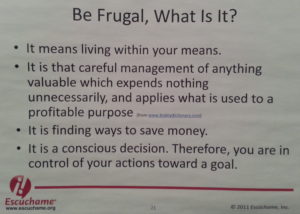
Mrs. Vélez eloquently described being frugal as:

  • Living within your means
  • Careful management of anything valuable which expends nothing unnecessarily, and applies what is used to a profitable purpose
  • Finding ways to save money
  • A conscious decision and you are therefore in control of your actions towards a goal

That slide was followed up with a description of what frugal is not:

  • Cheapness
  • Meanness
  • Bizarre behavior
  • Suffering
  • Difficult

Her talk helped me to see that there is in fact nothing wrong with being frugal, and re-enforced why it’s a good idea to be this way versus the alternatives; impulsive, frivolous and wasteful.  My discussions with Hardy described above and Mrs. Velez’s seminar also reminded me that labels and titles that we assign to each other are often subject to one’s point of view.

Though this post was written partially in a humorous way, these are important and serious lessons for everyone, especially in our society which actively promotes consumerism to all economic classes poor and rich, and attaches self-worth to material objects and luxuries of all kinds.

The Big Words LLC Newsletter

For the next phase of my writing journey, I’m starting a monthly newsletter for my writing and video content creation company, the Big Words LLC. In it, I plan to share inspirational words, pieces from this blog and my first blog, and select videos from my four YouTube channels. Finally, I will share updates for my book project The Engineers: A Western New York Basketball Story. Your personal information and privacy will be protected. Click this link and register using the sign-up button at the bottom of the announcement. If there is some issue signing up using the link provided, you can also email me at bwllcnl@gmail.com . Best Regards.

The Benefits and Challenges of Using Articulate Speech: Early Lessons on Culture, Education and Perception

“Why do you use those big words all of the time?”

articulate-speech

The following article was my inaugural submission for the Examiner back in November of 2012, and it’s very appropriate for my inaugural post on the Big Words Blog Site.  It hit upon one of the main themes of this site; the use of articulate speech.  One of the major rules for contributing to the Examiner was not writing in the first person point of view, something the publication policed very closely.  Hence in the piece, I’m not referring to myself directly.

Using Big Words

“Why do you use those big words all of the time?” a middle school student was asked by his classmates in the late 1980s. It was a diverse school, but these particular students were from the east side of Buffalo, for the most part, consisted of African American families.

Articulate speech, and big words were normal in his home. Both of his parents were college educated. His mother encouraged learning professional skills such as using proper typing techniques, though the importance of such skills were not well understood at the time by her sons. There were also plenty of books to read in the house. Public speaking was also encouraged at Sunday School every week at church.

Using big words helped him to earn his Ph.D. from a world renowned university. They allowed him to make very technical presentations, publish research articles, and to present himself well on job interviews.

As a scientist within the federal government, he made decisions that affected the health of the entire United States population. Articulate speech, the use of big words, and proper grammar were a part of his job performance; whether it was setting new policies, preparing documents, making presentations, and even collaborating with colleagues in foreign nations.

Articulate Speech

Ultimately being a major part of his success, his articulate speech caused difficulties throughout his life, particularly as a youth where it made him stand out from his peers, causing him to be perceived as different. He later found that being different was actually okay. As an adult, people continued to form opinions about him, positive or negative, based upon the way that he spoke. Nevertheless, his articulate speech ultimately opened several doors for him as he grew older.

The United States faces several challenges in the 21st century, one being the competition with other countries in the STEM fields (Science, Technology, Engineering and Mathematics). A strong command of the English language is key for success in these fields. Asia’s brightest scientists, for example, spend considerable time and energy learning the English language in order to establish their careers in the United States.

Speaking and writing often go hand in hand. In his book, Inside American Education, Thomas Sowell writes that the educational system in the United States needs to get back to the basics of teaching children how to read, write and how to do mathematics. The late Dr. Joseph Fail, Jr., of Johnson C. Smith University, published numerous articles encouraging students to be able to write effectively, particularly students of color.

Big Words and Race

In some communities speaking articulately is viewed as speaking proper or ‘white’. It also represents not having ‘street credibility’, which can be very important at an early age and even in adulthood, depending upon the social circle. This can be devastating for young people, ultimately locking them out of opportunities later in life.

In the Rich Dad Poor Dad series by Robert Kiyosaki, several compelling arguments are made for expanding one’s vocabulary, and ultimately speaking correctly. Even though financial literacy is the focus of the book, the importance of words is discussed as well. Robert eloquently describes words as important tools that unlock doors to life’s multiple possibilities.

Young people (and adults) need encouragement to the extent that a large vocabulary and articulate speech are valuable assets. They need affirmations that it is okay to read books and to speak well, even though it may make them feel different than their peers. They need confirmation that having a strong command of the English language is important in that it creates opportunities, opens doors, and builds bridges no matter what the professional field or discipline.

The Engineers: A Western New York Basketball Story Part One is available in the eBook, Hardcover and Paperback Editions

Writing a book was the genesis of my blogging and becoming a video content creator. I have published part one of my book project entitled, The Engineers: A Western New York Basketball Story. It is currently available on Amazon in eBook, hardcover, and paperback formats. The paperback format is available on IngramSpark, and signed hardcover and paperback copies on my online store entitled Big Words Authors via credit payment. Payment using Cash App, PayPal, Venmo and Zelle are also available. Reach out to me for further details. Finally visit the page discussing the book. Please consider visiting it to learn more about the project and see promotional content I’ve created surrounding the project.